There is a particular kind of disorientation that comes with flying into an unfamiliar city. One moment a traveler is suspended somewhere over a continent, sealed inside recycled air and artificial light, and the next they are standing in an airport terminal that looks, with uncanny consistency, like every other airport terminal in the world. The city itself — its texture, its rhythm, its particular smell — remains entirely absent. It has to be earned through a taxi queue or a train platform, accessed only after the bureaucracy of arrival has been processed. The first impression, in other words, is not of the city at all. It is of an airport.
The Geography of Getting There
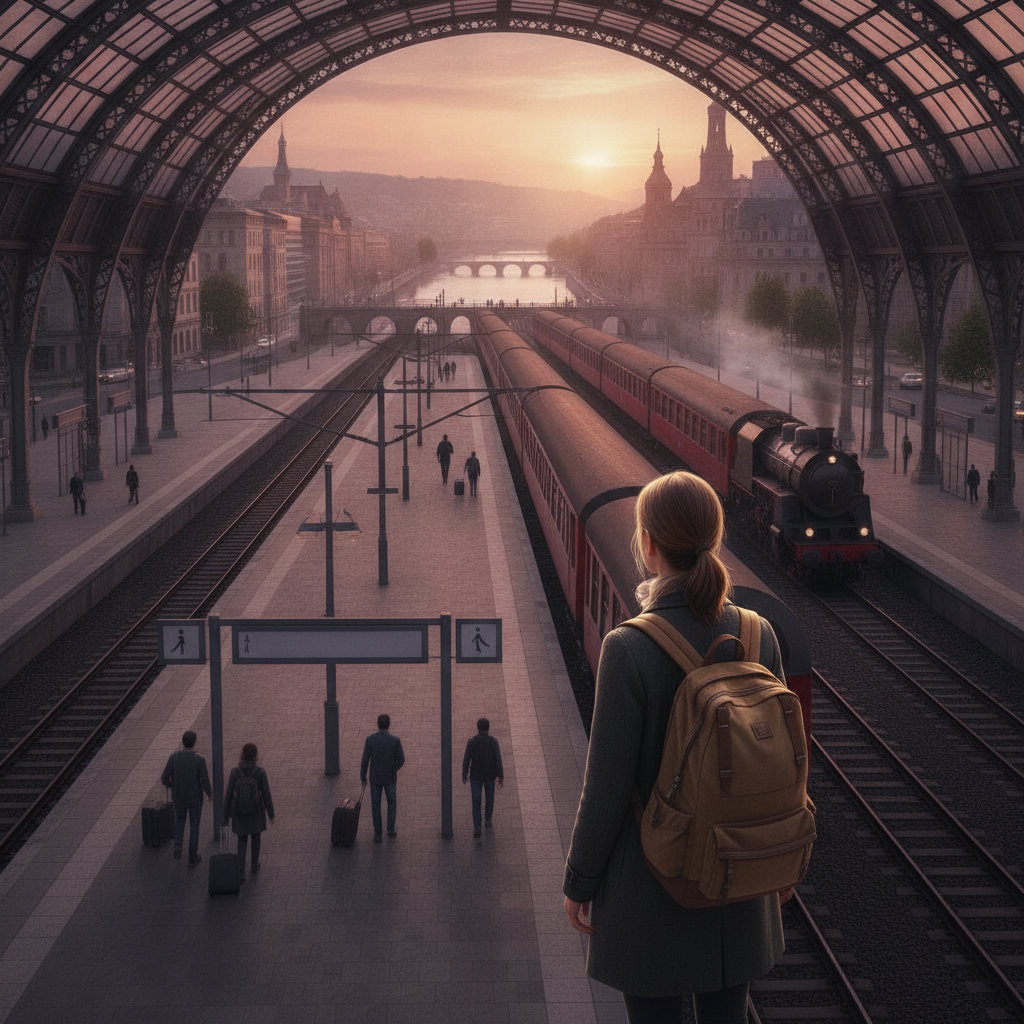
Train travel reverses this entirely. When a journey unfolds at ground level, the city does not appear suddenly; it announces itself gradually, in layers. Industrial outskirts give way to older neighborhoods. Rooftops multiply. Church spires or glass towers begin to cluster on the horizon. By the time a train pulls into Gare du Nord in Paris or Termini in Rome, a traveler has already witnessed something of the city's outer life — its housing patterns, its topography, the way it has grown outward from some older, denser core. This slow revelation carries real informational weight. It situates the traveler spatially in a way that dropping from the sky simply cannot. The geography of a place becomes legible before a single street has been walked.
This gradual approach also shapes mood in ways that matter. Flying compresses time so aggressively that the body and mind often lag behind the body's new coordinates. Train travel, by contrast, allows the traveler's internal clock to adjust in real time. The journey from Brussels to Amsterdam on a Thalys service, for instance, takes less than two hours but passes through enough distinct landscapes — flat Belgian farmland, then the geometric canals and low green fields of the Netherlands — that the transition from one country to another feels earned and tangible. Arrival feels like the conclusion of something, rather than a random punctuation mark.
What Central Stations Give That Airports Cannot
The architecture of great train stations is itself a kind of introduction to a city's character. Unlike airports, which tend toward the universal grammar of security theater and duty-free retail, central stations were often built as civic monuments — expressions of a city's ambition and identity at a particular moment in history. Antwerp-Centraal, sometimes called the Cathedral of Railways, greets arriving passengers with a Baroque dome and layered platforms that feel genuinely theatrical. Milano Centrale, with its vast Fascist-era stonework, says something unmistakable about scale and historical weight. Even more modest stations carry local flavor in their signage, their food stalls, their particular noise. A traveler stepping off a train in Kyoto, for example, enters a building that is itself a point of orientation — positioned deliberately close to the city's older historic districts, unlike the airport, which sits nearly an hour away.
The term *débarquement* — the French word for disembarkation, with its naval connotations of actually landing somewhere — captures what train arrival makes literal. The traveler has physically traversed the distance. They have moved through the country rather than above it. That embodied sense of having traveled, rather than merely having been transported, changes the quality of arrival in ways that are difficult to articulate but easy to feel.
The Neighborhood Effect of Station Proximity
There is also a practical dimension that compounds the atmospheric one. Train stations in most European and Asian cities sit at or near the geographic and cultural center of urban life. Arriving at Barcelona Sants or at Tokyo Station places a traveler within walking distance, or a single metro stop, from neighborhoods that are genuinely representative of the city's daily rhythms. The transition from train to street is short enough that the traveler's first real impressions — the light, the language on shop signs, the pace of pedestrians — are formed in the city proper, not in a transport corridor. Contrast this with arrivals at Charles de Gaulle or Narita, where the airport's own ecosystem can consume an hour before the city even begins.
This proximity also affects how travelers make their first instinctive decisions — where to eat, which direction to walk, which street looks worth exploring. When those first decisions are made in a real neighborhood rather than a transit hub, they tend to be better ones. The traveler is already embedded in context. They can see which café has locals at the window tables. They can hear whether the surrounding streets are quiet or lively. The city is already giving them information, and they have arrived early enough in the experience to receive it with fresh attention.
Arriving as a Participant, Not a Passenger
Perhaps the deepest difference between train arrival and plane arrival is psychological rather than logistical. Flying treats the traveler as a unit of freight — processed, tagged, and delivered. The journey itself is largely irrelevant, a delay between departure and arrival that most people prefer not to notice. Train travel restores the traveler to the role of participant. The route is part of the experience. The other passengers are real and proximate. The window is large. The landscape is continuous. By the time you step onto the platform at your destination, you have not just arrived somewhere — you have traveled there, in the fullest sense of the word. That difference in orientation, subtle as it sounds, shapes everything that follows: how alert you are, how curious you feel, how willing you are to wander without a fixed destination.
There is something worth preserving in that quality of arrival. The traveler who entered an airport hours ago, insulated from the landscape and sedated by the routine of air travel, often needs a full day to feel genuinely present in a new place. The traveler who watched the city assemble itself through a train window tends to feel present the moment they step outside the station. The city has already begun, and they arrived in time to see it start.