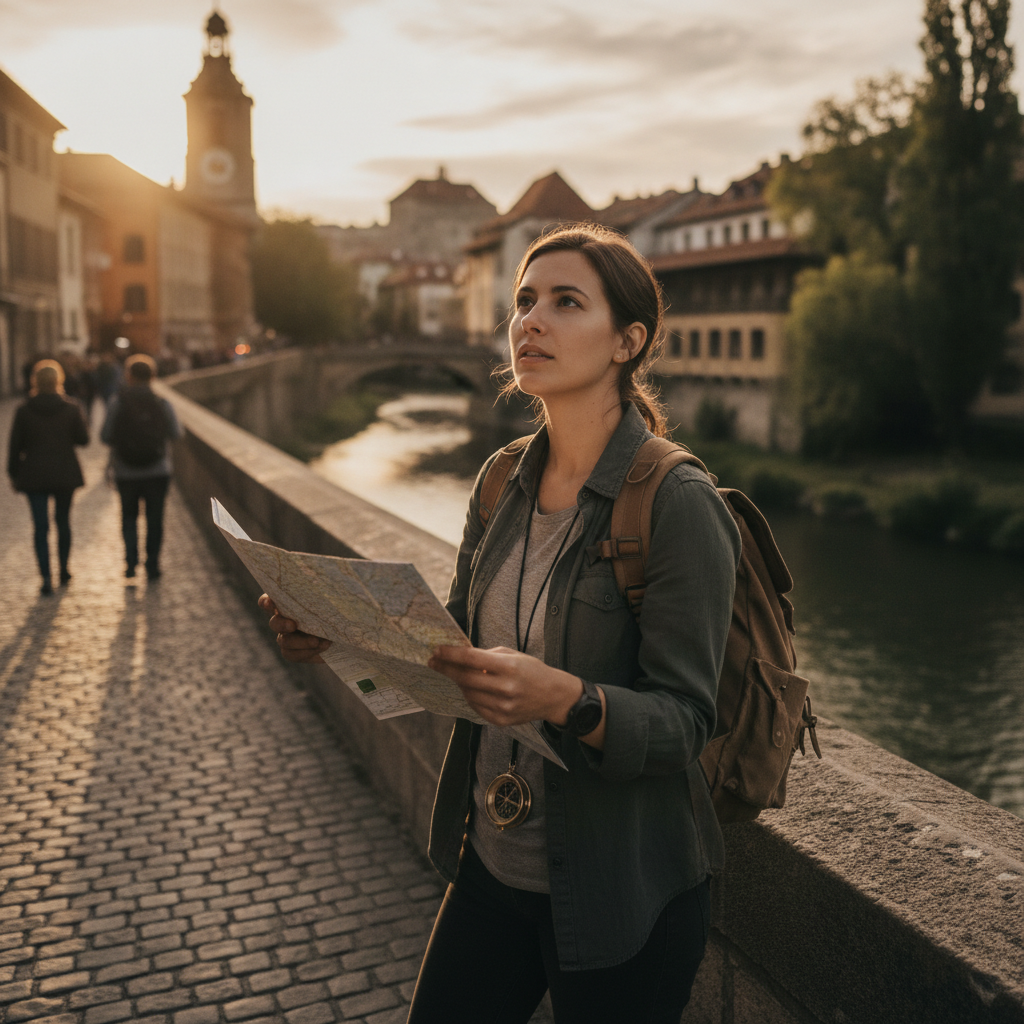
The airport exit is a strange threshold. One moment there's the familiar hum of departures and retail, and then the doors open and a new country arrives all at once — its air, its noise, its signage in a different hand. Most travelers reach immediately for their phones, searching for a signal or a SIM kiosk, trying to restore the digital layer before the physical one has even registered. That reflex is understandable, but what it costs is harder to see in the moment.
What Happens to the Brain When Connectivity Disappears?
Without a live data connection, the brain shifts its processing in a measurable way. The ambient monitoring that normally runs in the background — checking maps, reading notifications, confirming directions — stops, and the sensory load gets redirected outward. Travelers who skip the SIM for their first day consistently report a heightened attentiveness to their surroundings: the way streets are numbered, how locals signal for buses, which direction foot traffic naturally moves. This isn't a romantic notion. It's a straightforward consequence of removing one input source and forcing the others to compensate.
How Does Spatial Memory Form More Durably Without a Map?
Navigation apps are useful tools, but they function as external memory rather than internal learning. When a traveler follows a blue line from the train station to their accommodation in Lisbon's Alfama district or Istanbul's Beyoğlu neighborhood, they arrive having processed almost none of the route. Ask them an hour later to retrace it, and most can't. The spatial layout never encoded. When that same traveler has to pay attention — noting landmarks, reading street corners, asking a shopkeeper — the route embeds differently. Spatial memory built through active engagement is stickier, more detailed, and far more useful over the following days.
Why Does Disconnection Accelerate the Feeling of Arriving Somewhere Real?
There's a perceptual lag that comes with heavy digital mediation. A traveler who steps off a train in Porto or Oaxaca and immediately opens Google Maps is, in a real sense, still partly elsewhere — their attention split between the screen and the street. The SIM-free window collapses that lag. Without the option to retreat into a digital interface, the environment becomes the only available input, and that full presence tends to produce what experienced travelers describe as the sensation of a place becoming real. It's less mystical than it sounds: full attention simply allows richer encoding of what's actually there.
How Does Relying on Locals for Directions Change the Trip's Social Dynamic?
Asking for directions feels awkward until it doesn't. Within a few hours of relying on human navigation rather than digital, the interaction pattern shifts. A traveler who has asked three people for help — a pharmacist near a Marrakech medina entrance, a café owner in a side street, a teenager waiting for a tram — has already had more genuine contact than most tourists accumulate in a full day of app-assisted movement. These micro-interactions build a kind of social confidence that carries forward. They also tend to produce better information, since locals know which streets are closed, which market is actually worth finding, and which shortcut nobody maps.
What Practical Logistics Make the SIM-Free Window Actually Work?
This approach works best with minimal preparation rather than none. Before departure, you should screenshot your accommodation address with a nearby landmark, download an offline map through apps like Maps.me or the offline feature in Google Maps, and note the local emergency number. Carry the address written on paper as a backup. Research whether your destination's airport has a straightforward transit system — Tokyo's Narita Express or Amsterdam's direct train to Centraal are clean enough to manage without live data. The goal isn't to arrive helpless; it's to arrive without the reflex to outsource every decision before it forms.
How Long Should the Disconnected Window Actually Last?
Twenty-four hours is the useful threshold for most travelers. Less than that — say, a few hours to the hotel — produces some benefit but doesn't allow the instincts to fully engage. Beyond forty-eight hours, the practical friction can begin to outweigh the perceptual gains, especially in cities where language barriers are significant. One full day and night is enough time for spatial orientation to form naturally, for a few meaningful human exchanges to occur, and for the traveler to develop a working mental model of at least one neighborhood. After that, the SIM becomes a tool rather than a crutch — and that distinction makes all the difference.
Traveling without immediate connectivity isn't about rejecting technology or performing a kind of deliberate hardship. It's a simple recalibration: arriving in a place before importing a digital version of it. The travelers who do this regularly tend to build a stronger sense of place faster, form more memorable route knowledge, and feel more genuinely present from the first hours. The SIM card will be there at the corner shop tomorrow. The first impression of a new country only happens once.