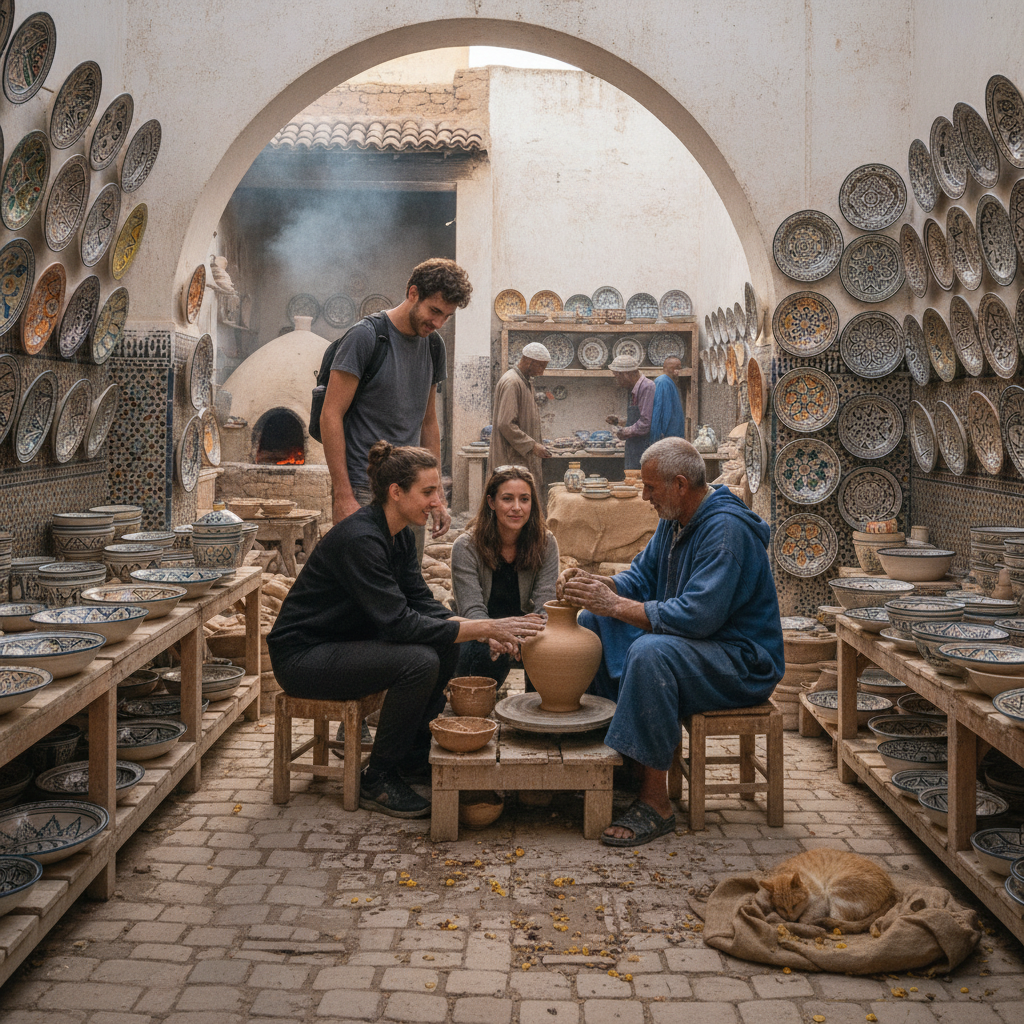
There is a particular stillness that settles over a traveler who watches a craftsperson at work — not performing for a camera, not demonstrating for a tour group, but simply doing what their family has done for generations. It is a stillness born of recognition, of witnessing something that no exhibition label or climate-controlled display case can adequately capture. Museums preserve what has already passed. Artisan traditions, at their best, are still in motion — still breathing, still arguing with modernity, still shaped by the hands of people who learned from the hands of people before them.
The Difference Between Preserved and Living Culture
Museums perform an essential function — they protect objects, contextualize history, and make the past accessible. But preservation, by definition, implies something removed from its original current. A Moroccan zellige tile mounted in a gallery is a beautiful artifact; watching a zellige craftsman in Fès score, chip, and assemble those geometric pieces on a workshop floor is something categorically different. The craft is embedded in a specific economy, a specific neighborhood, a specific lineage of knowledge passed down through apprenticeship rather than textbooks. When a traveler centers their trip around engaging with that tradition — not simply observing it — they enter the living version of the story, with all its contradictions, pressures, and irreplaceable texture.
How Craft Traditions Carry Encoded Cultural Knowledge
Every artisan tradition carries within it a compressed record of the culture that produced it. The particular dyes used in Oaxacan textiles — derived from cochineal insects and local plants — reflect centuries of ecological relationship between Zapotec weavers and their specific landscape. The joinery techniques of Japanese tansu furniture speak to a philosophy of concealment, precision, and longevity that extends far beyond woodworking into broader aesthetic values. When a traveler takes even a short workshop with a local artisan, or spends time in the market quarter where a craft is practiced and sold, they begin to decode these embedded meanings. The craft becomes a lens through which geography, history, trade routes, and social structure suddenly become legible in a way that reading about them never quite achieves.
This kind of cultural comprehension accumulates gradually, through repetition and sensory experience. Feeling the weight of Rajasthani block-printed fabric, understanding which patterns belong to which community, learning that certain motifs were historically reserved for ceremonial use — this is knowledge that enters through the hands and eyes as much as through the mind. It tends to stay.
Choosing a Destination Around a Craft Anchor
Planning a trip around a specific craft tradition changes the entire architecture of a journey. Rather than compiling a list of attractions and moving through them efficiently, the traveler begins to build their itinerary around a center of gravity. Kyoto, for instance, offers a coherent world for those drawn to nishiki-ori weaving or kintsugi, the practice of repairing broken ceramics with gold lacquer — a tradition that embeds a philosophy of honoring imperfection rather than concealing it. Oaxaca structures itself naturally around its textile, ceramic, and mezcal traditions in ways that reward slow exploration across multiple neighborhoods. The Alentejo region of Portugal has become a destination for those interested in azulejo tilework and traditional cork craftsmanship, where workshops, studios, and family producers are woven through ordinary village life rather than sequestered in tourist corridors.
This kind of anchor creates coherence. Meals, accommodations, and side excursions begin to organize themselves around the central interest, and the trip develops a narrative shape rather than a checklist shape.
What Participation Unlocks That Observation Cannot
There is a meaningful distinction between watching a craft and attempting it, even briefly and imperfectly. Participation — however clumsy — shifts the traveler's relationship to the tradition from spectator to student, however temporary. That shift matters. It creates a quality of attention that passive observation rarely sustains. A traveler who has spent two hours trying to control the tension of a backstrap loom in a Guatemalan cooperative will watch every other weaver they encounter with entirely different eyes for the rest of the trip. They will notice technique, variation, speed, the relationship between body and tool. They will ask better questions. They will also understand, in a concrete rather than abstract way, what the finished object represents in terms of time, skill, and sustained physical attention.
Many regions now offer structured engagement through craft cooperatives — organizations where artisans have pooled resources to offer workshops, fair-trade purchasing, and educational exchanges. Visiting a cooperative rather than a curated craft market also tends to direct more economic benefit toward the makers themselves, which carries its own significance for the traveler who wants their presence in a community to leave something useful behind.
The Ethics and Etiquette of Craft Travel
Engaging with artisan traditions as a traveler carries responsibilities that are worth considering before arrival. Photographing artisans without permission, bargaining aggressively below a fair price, or purchasing mass-produced imitations of traditional crafts all chip away at the very culture the traveler came to encounter. In many communities, certain motifs, patterns, or techniques carry cultural or spiritual significance — the huipil garments worn by indigenous women in parts of Mexico and Guatemala, for instance, carry encoded information about the wearer's community and identity. Understanding these dimensions before engaging with them is a form of respect that transforms tourism into something closer to genuine cultural exchange.
Researching a tradition in advance — its history, its practitioners, its economic pressures — allows the traveler to arrive with context rather than only curiosity. That preparation tends to make the experience richer for both visitor and host.
What You Carry Home That No Shop Can Sell
When you return from a trip organized around an artisan craft tradition, what you bring back is rarely just an object. It is a set of associations: the smell of a workshop, the sound of a particular tool, the face of the person who showed you how something worked. The purchased piece — whether a small hand-thrown bowl from a Provençal potter or a length of indigo-dyed cloth from a studio in Kyoto — carries those associations within it in a way that a souvenir cannot. It becomes a form of condensed memory, a physical anchor to an experience that expanded your understanding of how a culture thinks and values and makes.
This is what artisan-centered travel offers that no museum visit, however well-curated, can fully replicate: the chance to witness a living tradition in its actual environment, shaped by real economic pressures and real human choices, and to carry some small part of that understanding home in a form that continues to mean something long after the journey ends. The stillness that settles over a traveler watching a craftsperson at work is, in that sense, only the beginning of what there is to understand.