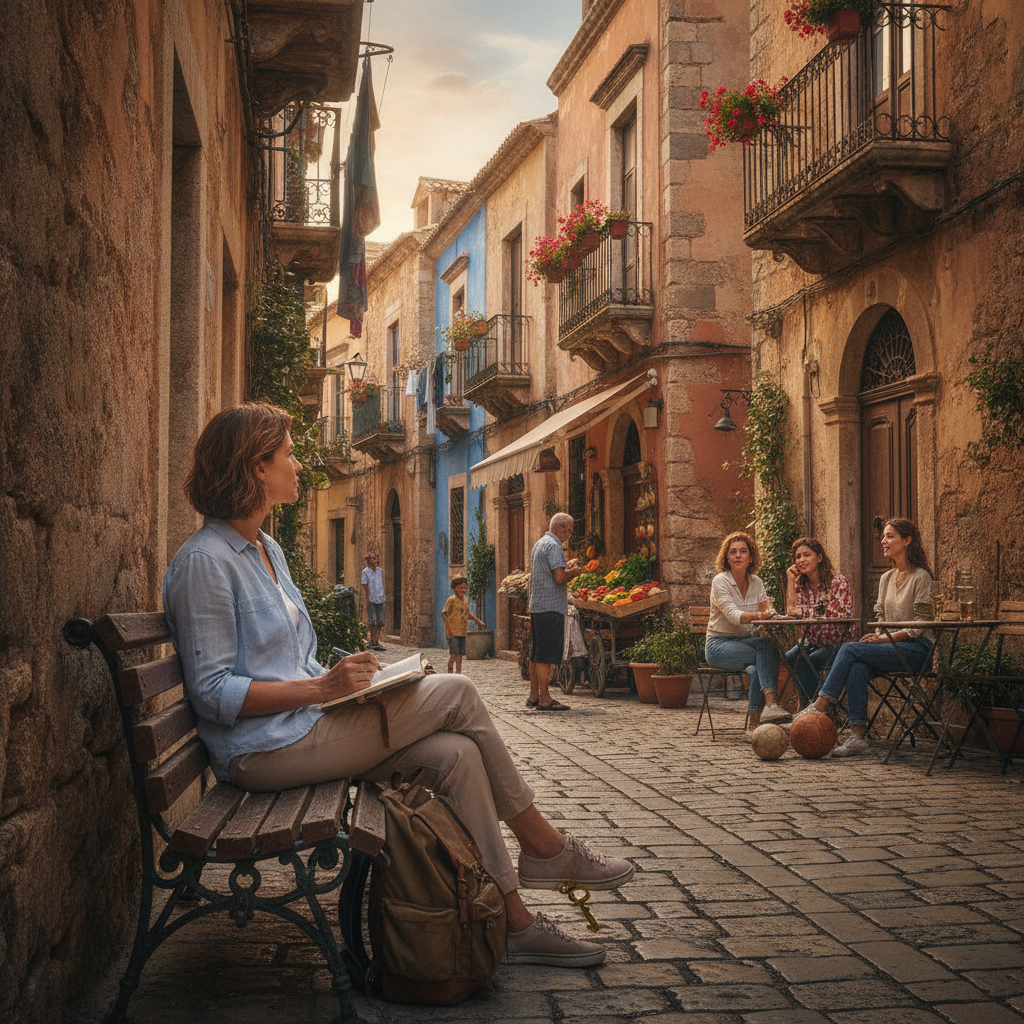
Most travelers arrive in a new city and head straight for convenience — the hotel near the airport, the well-reviewed chain near the central station, the serviced apartment in the tourist corridor. It's an understandable instinct. After a long journey, familiar comforts feel like a reasonable reward. But where you spend that first night shapes far more than your sleeping arrangements. It calibrates your entire sensory and social frame for the days that follow.
Why the First Night Sets Everything Else in Motion
The brain doesn't process a new city neutrally. It anchors to whatever environment it encounters first, using those early impressions as a reference point for everything that comes after. When the first neighborhood a traveler walks through is lined with chain cafés, souvenir stalls, and English-language menus, the city's texture gets flattened before it's even properly seen. By contrast, arriving in an older residential quarter — somewhere like Alfama in Lisbon, Balat in Istanbul, or Le Panier in Marseille — places you immediately inside the living rhythm of the place rather than its performance of itself.
Older residential quarters aren't curated for visitors. The butcher has been there for forty years. The corner bar doesn't have cocktail umbrellas. The smell of the stairwell in a converted Ottoman townhouse is genuinely unrepeatable. These details matter not because they're picturesque, but because they're honest. They tell a traveler what the city actually values, how its residents move through their days, and what the built environment has chosen to preserve.
What Older Neighborhoods Reveal That Newer Districts Don't
City centers rebuilt for tourism tend toward sameness. Pedestrianized zones, rooftop bars with view pricing, and ghost-kitchen delivery hubs increasingly occupy the spaces that once held bakeries, shoe-repair shops, and neighborhood pharmacies. Older residential quarters have usually resisted this pressure — not always perfectly, but enough to maintain a legible sense of continuity. The street grid itself carries memory.
Spending even a single night in one of these areas creates a kind of perceptual download that's difficult to replicate later. A traveler who walks to a local panetteria for breakfast on day one has already learned something about pace, about how long a transaction takes when there's no queue-management system and the owner actually wants to talk. That knowledge recalibrates expectations for the whole trip and makes the traveler a more patient, more curious participant in everything that follows.
The contrast becomes especially clear when travelers backtrack to older quarters later in a trip. By then, tourist fatigue has set in, and the neighborhood can feel like relief rather than revelation. Starting there inverts that dynamic entirely.
How Accommodation Choice Shapes Daily Logistics
There's a practical layer to this strategy that goes beyond atmosphere. Older residential quarters tend to offer smaller, independently run guesthouses and apartment rentals that are priced against local demand rather than tourist-peak rates. Platforms like Airbnb and Booking.com both carry listings in these areas, but the highest-value finds are often the properties run by families who've been hosting for years without aggressively optimizing their profiles.
Staying in one of these properties also restructures the traveler's default morning. Without an international breakfast buffet, the instinct is to go outside earlier, to figure out where the neighborhood actually eats. That small inconvenience becomes the first genuine local encounter of the trip. A café recommendation from a host, a market stall pointed out by a neighbor — these aren't manufactured experiences. They're the incidental byproducts of being in a place that wasn't designed to manage you.
The Psychological Effect of Genuine Surroundings
Travel researchers and urban planners have long observed that the environments people inhabit during transitions — arrivals, departures, new beginnings — carry disproportionate weight in how they interpret what follows. A traveler who spends their first night surrounded by centuries-old architecture, narrow streets worn smooth by foot traffic, and the ambient sounds of actual residents going about their evenings arrives at day two with a fundamentally different posture than one who spent the same night in a business hotel by the ring road.
This isn't romanticism. It's closer to calibration. The older quarter provides a baseline of authenticity against which the rest of the city can be understood. When the traveler later visits a museum, a market, or a modern district, they bring a reference point that was formed from lived observation rather than from a guidebook description. That shift in perspective is hard to manufacture deliberately — but it happens almost automatically when the first accommodation is chosen well.
Making the Choice Work in Practice
If this approach appeals to you, the practical steps are straightforward. Before booking, research which neighborhoods in your destination qualify as genuinely old and still primarily residential — not gentrified-historic, but lived-in. In Rome, that might mean Testaccio rather than Trastevere. In Kyoto, Nishijin rather than Gion. In Barcelona, Gràcia rather than the Gothic Quarter, which has become more tourist infrastructure than neighborhood.
Search for accommodations run by individuals rather than management companies. Read reviews carefully for signs that the host actually knows the neighborhood — recommendations for specific local spots, descriptions of the morning market two streets over, mentions of the corner bar that doesn't appear on Google Maps. Arrive with enough time to take a slow evening walk before dinner. Don't plan anything structured for that first night. Let the neighborhood present itself without an agenda.
If you can only swing one night there before moving to more convenient accommodation elsewhere in the city, that's still enough. The impression will carry.
The oldest residential quarters of any city hold the longest memory, the most honest rhythms, and the greatest concentration of what the place actually is beneath its tourist surface. Starting there doesn't guarantee a perfect trip — nothing does — but it gives every day that follows a richer foundation. That foundation, quietly and reliably, changes what you notice, what you ask, and what you carry home.