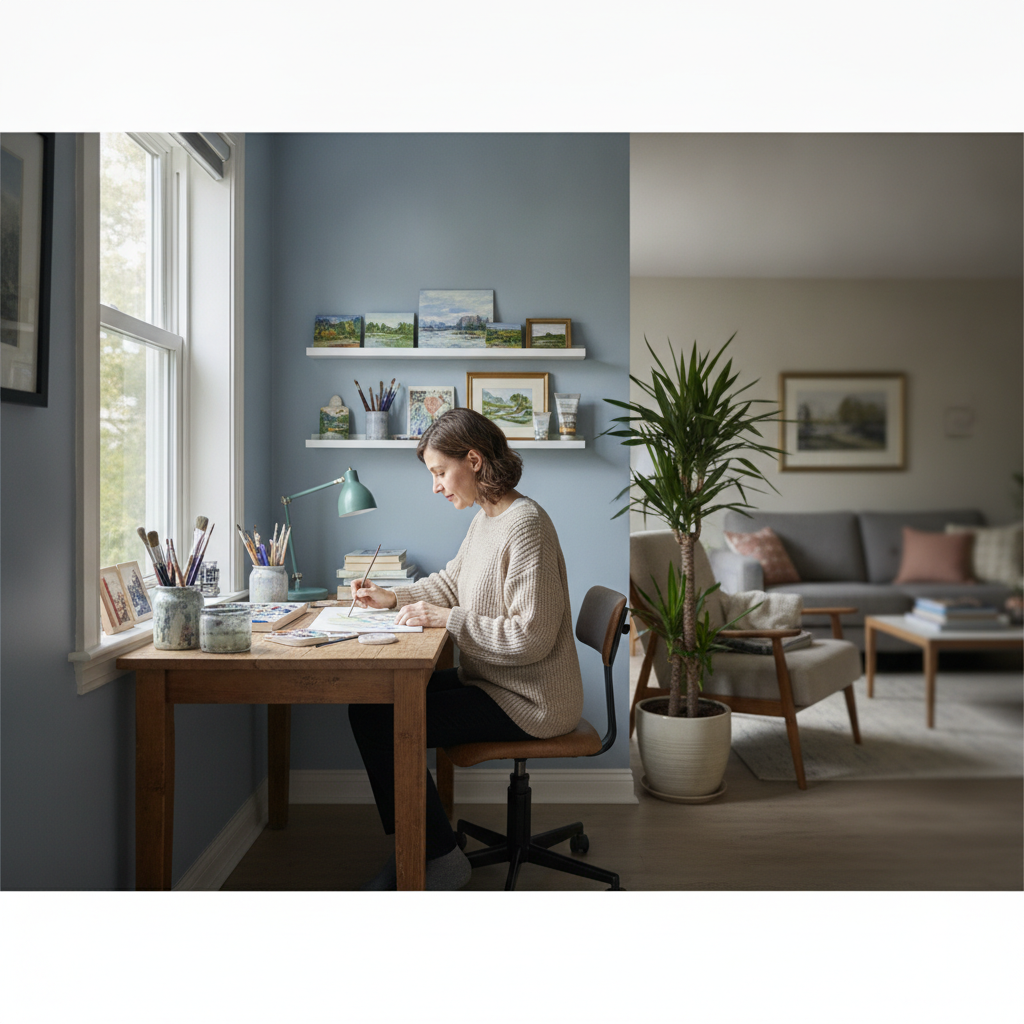
A hobby left without a home rarely survives. You might love watercolor painting or woodworking or sourdough baking in theory, but when your supplies are packed into a closet or scattered across three rooms, the activation cost of getting started quietly kills the impulse. Small homes make this problem feel permanent, like there simply isn't room for the things that bring you genuine joy. The good news is that a dedicated hobby space doesn't require a spare room or a major renovation — it requires a different way of thinking about the square footage you already have.
Treat Your Hobby Space as Non-Negotiable Square Footage
The first shift is psychological. Most people in small homes think of hobbies as guests — they get whatever space is left over after everything else is settled. Reversing that logic changes everything. When you decide that your hobby occupies a fixed corner, shelf system, or rolling cart that stays set up and ready, the space starts working for you instead of against you. IKEA's RÅSKOG cart, for example, has become a popular choice for artists and crafters in studio apartments because it's mobile, compact, and keeps everything visible. Visible means accessible, and accessible means you'll actually use it.
Start With a Commitment Audit Before Buying Anything
Before rearranging furniture or ordering shelving, spend a week noticing when and why you avoid your hobby. Often the barrier isn't space itself — it's setup time, cleanup friction, or not being able to leave a project mid-progress. Write down what a realistic session looks like: how long it takes, what materials you actually use, what you wish you could leave out overnight. That audit becomes your design brief. It tells you whether you need a pegboard, a dedicated drawer, a fold-down desk from a company like Prepac, or simply a cleared shelf at eye level.
Choose a Spot Based on Light, Noise, and Natural Timing
Where you put your hobby space matters almost as much as having one. A reading nook placed near your best natural light source will get used more than the same chair tucked in a dim corner. A music corner near a window in the morning invites you differently than one facing a blank wall in the afternoon. Think about when you naturally want to engage with your hobby and what conditions your energy matches at that time. Pairing the physical spot with a naturally occurring window in your schedule — a slow Sunday morning, a post-dinner wind-down — reinforces the habit without requiring willpower.
Use Visual Cues to Lower the Activation Threshold
One of the most underappreciated principles in small-space design is that what you see regularly, you do regularly. Keeping your guitar on a wall mount instead of in a case, your sketchbook open on a stand instead of closed in a drawer, or your knitting project in a clear bag on the coffee table instead of packed away — these choices all reduce the mental distance between you and starting. Apps like Houzz are useful for visualizing arrangements before committing, but the core idea is simple: out of sight genuinely is out of mind, and a hobby that requires effort to access will always lose to the easier option nearby.
Build a Micro-Ritual Around Entering the Space
Physical space works best when it's paired with a simple behavioral trigger. This doesn't need to be elaborate — brewing a specific tea, putting on a particular playlist through Spotify, or simply clearing one surface before sitting down can signal to your brain that you've shifted into creative mode. These micro-rituals build an association between the space and a focused mental state, which means the transition into your hobby becomes faster and more reliable over time. The space trains the mind, and the ritual reinforces the space.
Prioritize Cleanup Systems as Much as Storage
Many hobby spaces fail not because of poor setup but because cleanup is too slow or too vague. If it takes fifteen minutes to put everything away properly, you'll start avoiding sessions when you only have forty minutes to spare. Design your cleanup system with the same attention you give your setup. Labeled bins, a dedicated trash spot, a rinse station for painting supplies, a lint roller hung next to your sewing area — these details remove the low-grade dread that accumulates around creative messes. A space that's easy to restore invites you back sooner.
Protect the Space From Competing Household Uses
In small homes, multipurpose surfaces are practical, but they can quietly erode a hobby space over time. When the dining table doubles as a craft area and a bill-paying station and a homework surface, no single use feels fully supported. Even a symbolic boundary helps — a small sign, a specific tablecloth used only during hobby time, or an agreement with housemates that a certain corner stays clear. Neighborhoods like those filled with compact urban apartments in cities like Portland or Melbourne have seen a growing culture of micro-studio design precisely because people have learned that boundaries, even small ones, make a meaningful difference.
Upgrade the Space Gradually to Match Your Commitment Level
Start minimal and let your actual usage guide the investment. A dedicated shelf costs almost nothing; a built-in workbench costs considerably more. When you notice that you're using the space consistently — reaching for your materials without thinking, lingering longer than planned, feeling genuinely pulled toward the activity — that's the signal to upgrade. Better lighting, proper ergonomic seating, a larger work surface. Each improvement rewards commitment rather than assuming it. This approach also keeps the space honest: you build it up only as fast as you actually show up for it.
Creating even a modest, intentional corner for the things you love isn't a luxury — it's a practical decision that changes behavior in measurable ways. The space removes friction, builds habit, and signals to yourself that your interests deserve room in your life. Start with one shelf, one cleared corner, one system that makes beginning easier than avoiding. That's enough to change the pattern.