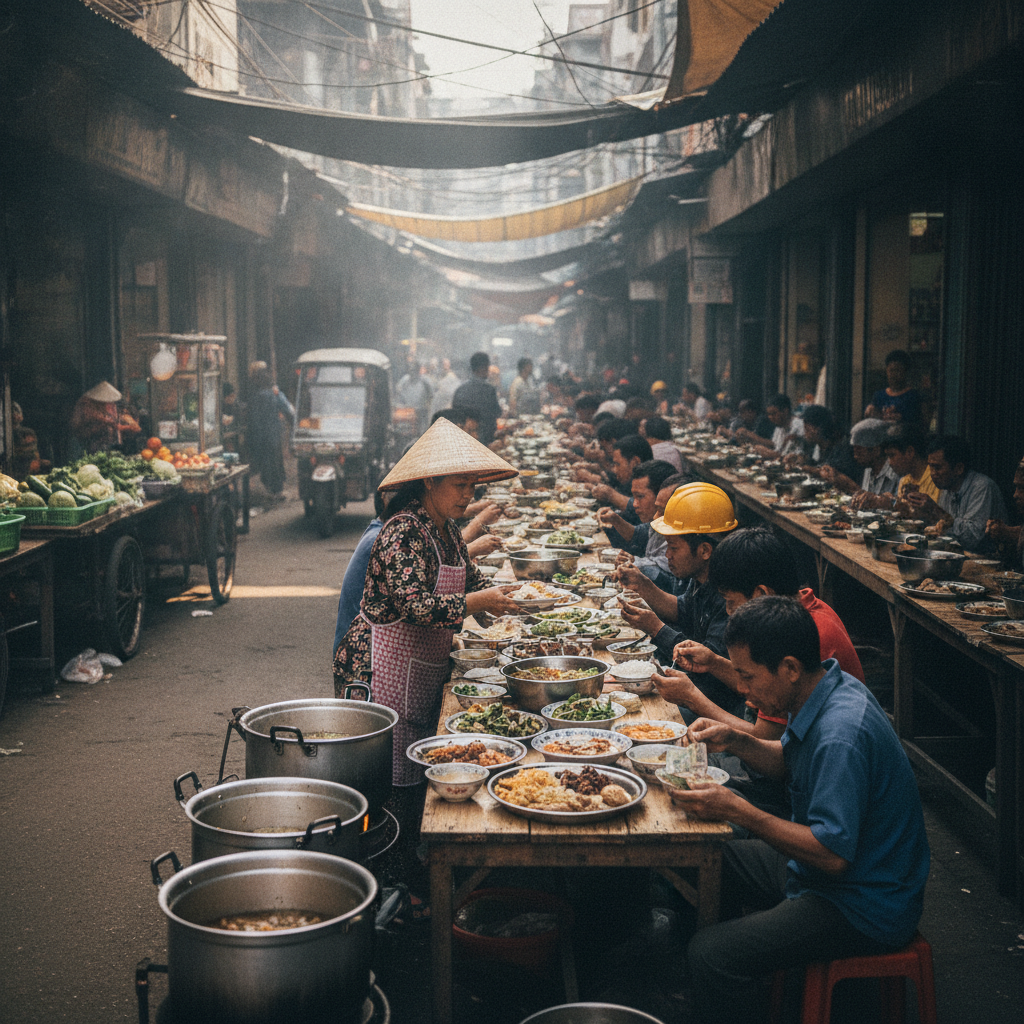
There is a version of travel that most people never quite reach — not because it requires special access or insider knowledge, but because the instinct to default to comfort is remarkably persistent. The guidebook restaurant, the hotel breakfast buffet, the café with a bilingual menu: these choices are understandable, even defensible, but they quietly insulate the traveler from the economic texture of ordinary life at a destination. A single meal, taken once a day at the kind of canteen that construction workers, civil servants, and market vendors actually use, dismantles that insulation more efficiently than almost any other practice a thoughtful traveler can adopt.
What Workers' Canteens Actually Represent
Across much of Southeast Asia, Latin America, and parts of Southern and Eastern Europe, street-level eating establishments serving the local workforce are not informal or incidental — they are a structural part of urban life. In Vietnam, the *cơm bình dân* (literally "common people's rice") is a recognizable institution: a cluster of plastic stools, steam trays of prepared dishes, and a price point calibrated entirely to what a day laborer can spend on lunch without thinking twice. In Mexico, the *comida corrida* — a set midday meal offered at neighborhood fondas — functions with the same logic. In Istanbul's older districts, *esnaf lokantası* (tradesman's restaurants) operate on the same principle: generous, rotating daily menus priced for the artisan class, not the tourist. These places share a philosophy of value-per-calorie that has nothing to do with hospitality theater and everything to do with economic reality.
The Pricing Education a Single Meal Provides
The most immediate effect of eating at a workers' canteen is that it recalibrates the traveler's entire pricing frame for the rest of the trip. When a full plate of rice, two proteins, a vegetable, and a soup costs the equivalent of a cup of coffee at the hotel lobby café, the inflated margins of tourist-facing restaurants become impossible to ignore. This is not about frugality as an ideology — it's about understanding what things actually cost at the ground level of a local economy. A traveler who has eaten at a *thali* canteen near the textile markets of Ahmedabad or at a workers' lunch counter in Lisbon's Mouraria district carries a calibration that reshapes every subsequent spending decision. They know what a real meal costs in that city. That knowledge is protective, clarifying, and surprisingly difficult to acquire any other way.
Rhythm, Not Just Price
Beyond pricing, the workers' canteen teaches something less tangible but perhaps more durable: the rhythm of the working day. These establishments open and close according to labor schedules, not tourist convenience. The lunch service at a Bangkok construction-site canteen may run from eleven in the morning until half past twelve, after which the food is gone and the tables are cleared. The *menu del día* at a small fonda in Oaxaca's working neighborhoods begins at one and is finished — truly finished — by three. Arriving at these windows requires the traveler to reorganize their day around local time rather than tourist time, and that reorganization is genuinely instructive. It reveals when the city breathes, rests, accelerates, and quiets in ways that no walking tour or cultural briefing can replicate.
The Social Layer That Opens Gradually
Workers' canteens are not, in any formal sense, social spaces designed for visitors. That distinction is precisely what makes them valuable. A traveler who sits at a shared table in a neighborhood canteen near the port district of Thessaloniki, eating the same daily special as the dock workers on either side, exists briefly outside the tourist-service relationship — not as a customer to be accommodated, but simply as someone who showed up and sat down. The interactions that emerge from that positioning tend to be brief, unperformed, and surprisingly honest. Directions given are practical rather than promotional. Opinions about local life, when offered, reflect genuine experience. The traveler collects these fragments without necessarily collecting full conversations, and over time they accumulate into something that feels closer to actual contact with a place than most curated experiences can provide.
How to Find These Places
Workers' canteens do not advertise on platforms like TripAdvisor or Google Maps in any meaningful way, which is largely what preserves their character. The most reliable method of locating them is the oldest: arriving in a neighborhood before noon on a weekday and watching where groups of workers in practical clothing walk with purpose. Near industrial zones, market districts, hospital staff entrances, and government administration buildings in cities like Porto, Hanoi, or Bogotá, these establishments cluster around working-life infrastructure rather than tourist infrastructure. A traveler who identifies the nearest large market, hospital, or municipal building to their accommodation and walks within a few blocks of it at eleven-thirty on a Tuesday morning will almost always find what they're looking for within minutes. The signs, if any exist, tend to be hand-painted and specific: a dish name, a price, an arrow.
Making It a Single Daily Practice
The approach works best as a deliberate constraint rather than an occasional experiment. Committing to one meal per day — typically lunch, which is when these canteens operate at full capacity — at a workers' establishment, while keeping dinner flexible, creates a structure that balances cultural immersion with practical comfort. It also has a measurable effect on the overall trip budget, since the midday meal at a tourist-facing restaurant often represents the single largest daily food expenditure. For a traveler spending a week in a mid-sized city, the cumulative saving can be significant without requiring any sacrifice in satisfaction. The food at these canteens is, almost universally, honest, fresh, and adapted to local taste rather than to imagined foreign preferences — which makes it, by any reasonable measure, better.
The traveler who commits to this practice for even three or four days of a longer trip tends to return from the experience with a fundamentally different picture of the places they visited. Not richer in landmarks or famous meals, but richer in something harder to name — the sense of having brushed against the actual cost of a life lived there, against the actual pace of a day unfolding as it does for the people who never leave. That is the same knowledge that was unavailable at the hotel breakfast, and it turns out to be the most useful thing a traveler can carry home.