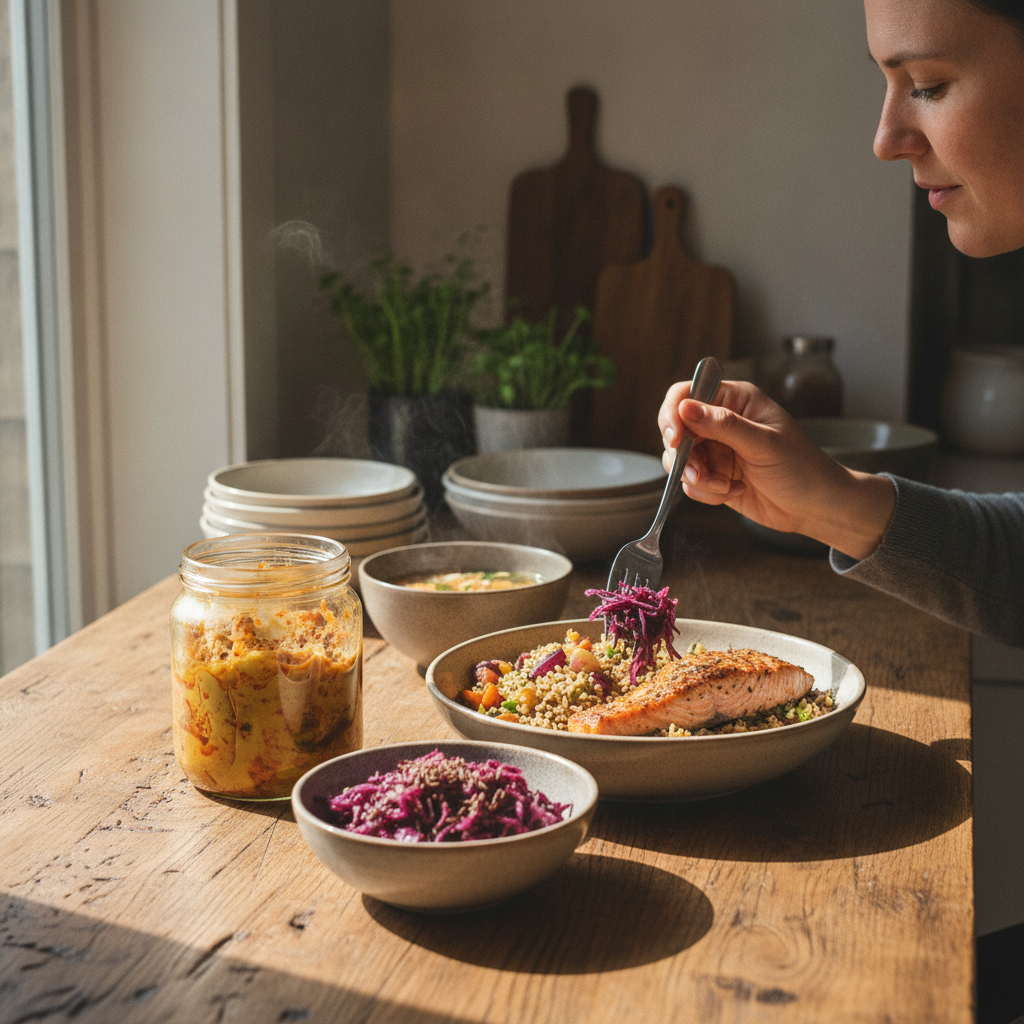
Fermented foods are genuinely powerful tools for gut health, but most people treat them as an afterthought — a spoonful of kimchi on the side, a kombucha cracked open between meals, a dollop of yogurt whenever it's convenient. The timing and placement of these foods within a meal, however, makes a meaningful difference in how much benefit actually reaches your gut microbiome. Getting this right doesn't require a new diet or expensive products. It just requires a small shift in sequencing.
You're probably already including some fermented foods in your week — maybe Bubbies sauerkraut alongside a sandwich, or a glass of GT's Kombucha after work. The habit is good. The placement can be better. Gut bacteria are sensitive to the environment they land in, and what surrounds a fermented food when it enters your digestive system either supports or undermines the live cultures it contains.
Eat Fermented Foods Before or During Your Meal, Not After
Consuming fermented foods at the start of a meal or woven through it — rather than as a finishing garnish — gives the live cultures a better chance of surviving transit through your stomach. When food is already present in the stomach, gastric acid output is partially buffered, creating a slightly more hospitable environment for bacteria. Starting with a few bites of kimchi, miso soup, or a small portion of plain kefir before the main event primes both digestion and the conditions that allow beneficial microbes to take hold further down the digestive tract.
Pair Fermented Foods With Fiber-Rich Ingredients
Live cultures need something to feed on once they reach your colon, and fiber is that fuel. Pairing fermented foods with vegetables, legumes, or whole grains during the same meal creates a kind of relay effect — the bacteria arrive with food waiting for them. A bowl of lentil soup topped with a spoonful of plain yogurt, or a grain bowl with a side of pickled vegetables, sets up this relationship naturally. Processed, low-fiber meals don't offer the same runway, so the microbiome benefit tends to be shorter-lived and less pronounced.
Avoid Eating Fermented Foods Alongside Very Hot Dishes
Heat above roughly 40°C begins to compromise the viability of live cultures, which is why stirring yogurt into a boiling curry or adding miso paste to aggressively simmering broth defeats much of the purpose. The fix is straightforward: add fermented ingredients after cooking, once a dish has cooled slightly. Stir miso into warm, not hot, broth. Fold yogurt into a dish that's been resting for a couple of minutes. This small adjustment preserves the microbial content without changing the flavor or texture in any noticeable way.
Use Fermented Foods as a Bridge Between Courses
If you eat in stages — a starter, a main, something light afterward — inserting a fermented element between courses rather than at the end is a strategic move. A small glass of plain kefir, a few forkfuls of Wildbrine kimchi, or a portion of brine-packed olives between courses keeps digestive enzymes active and introduces beneficial microbes at a point when the gut environment is engaged and moving. This isn't a rigid rule, but it's a useful frame when you're trying to make fermented foods do more than just show up on the plate.
Don't Wash Fermented Foods Down With Cold Drinks Immediately
Cold liquids consumed immediately alongside fermented foods can slow gastric motility and alter the stomach environment enough to affect how live cultures travel through. Drinking cold water or iced beverages right as you eat a fermented food isn't catastrophic, but waiting even ten minutes — or opting for room-temperature water — gives the cultures a cleaner passage. This is especially relevant if you're eating a probiotic-rich food like plain Siggi's yogurt or a live-culture pickle as a focused part of your meal rather than incidentally.
Rotate Your Fermented Foods Across the Week
Different fermented foods carry different strains of beneficial bacteria, and each strain interacts with the gut ecosystem in its own way. Eating the same fermented food every day in the same position within your meal delivers a narrower range of microbial diversity than rotating through options across the week. Kimchi, sauerkraut, kefir, miso, tempeh, and traditionally made pickles each bring something distinct. Varying them — and timing each one intentionally within meals rather than reaching for the same jar every evening — broadens the microbiome impact considerably.
Eat Smaller Amounts More Frequently Rather Than One Large Serving
A single large serving of fermented food once a day is less effective than smaller, distributed portions across multiple meals. The gut microbiome responds better to consistent, repeated exposure than to occasional large doses. Two or three modest portions — a tablespoon of sauerkraut at lunch, a half-cup of kefir at breakfast, a few bites of tempeh at dinner — distributed across the day and positioned thoughtfully within each meal creates a steadier stream of microbial reinforcement than one significant serving eaten without much thought about context or timing.
Let Fermented Foods Anchor Meals That Include Antibiotics or Processed Ingredients
On days when circumstances push your diet toward more processed foods, or when you're taking a course of antibiotics, strategic placement of fermented foods becomes even more valuable. Antibiotics and highly processed ingredients can disrupt microbial balance, and eating a fermented food at the beginning or middle of those meals — rather than skipping them entirely — gives the gut something to work with. It won't counteract a full antibiotic course on its own, but it provides a meaningful counterbalance and keeps the habit consistent so you're not starting from scratch when conditions improve.
Research interest in chrono-nutrition — the study of how meal timing affects biological outcomes — is expanding, and gut microbiome science is increasingly part of that conversation. As understanding deepens, the advice on fermented food placement is likely to become more precise, with clearer guidance on which bacterial strains benefit most from specific meal environments. For now, the practical approach is already well-supported: be intentional, vary your sources, and think of fermented foods as active participants in your meal rather than decorative additions. Small adjustments to sequencing and pairing consistently outperform sporadic, haphazard consumption.