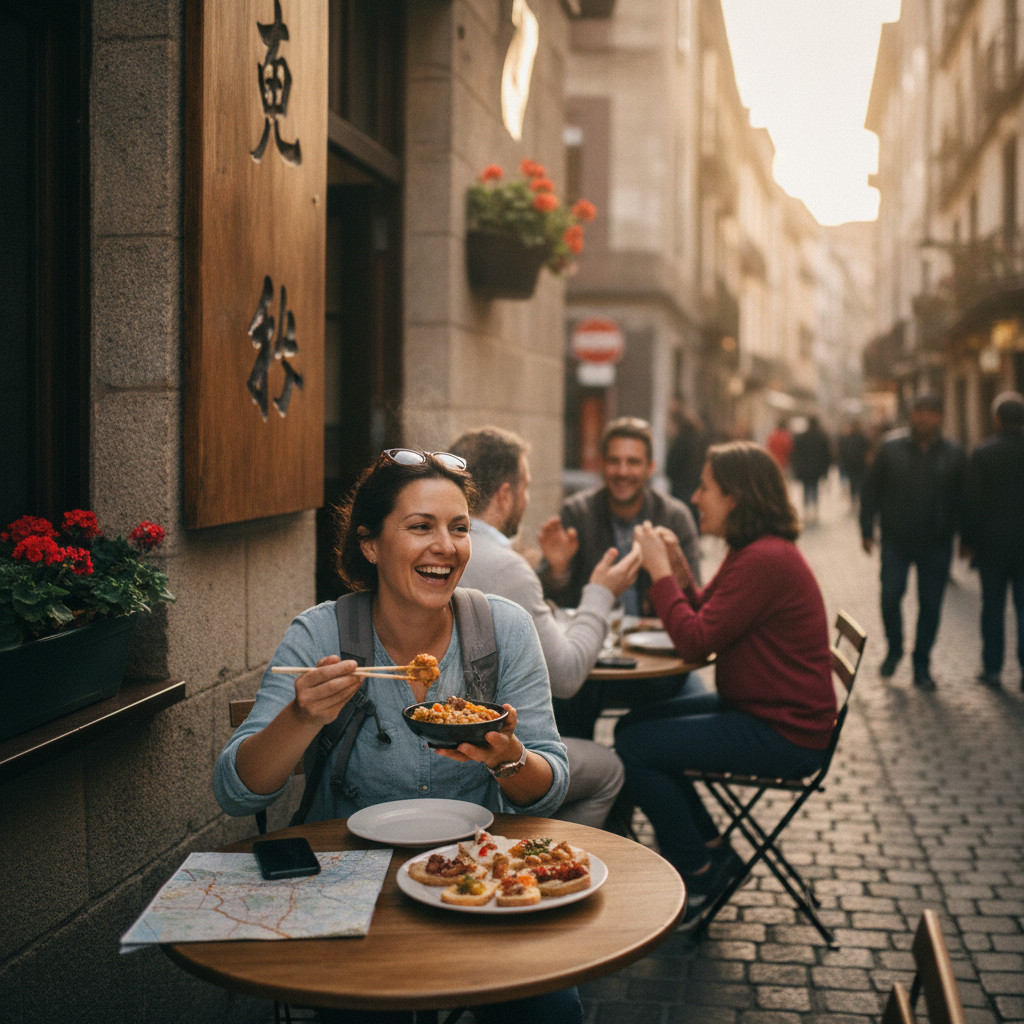
There is a particular quality of attention that arrives the moment a traveler realizes the menu in front of them contains not a single recognizable word. The usual shortcuts — the familiar dish names, the translated descriptions, the English-language photographs staged for foreign eyes — are gone. What remains is something more honest: the actual texture of a place, unfiltered, requiring full presence to read.
This is the quiet transformation that happens when a traveler commits, for just the first two days of a trip, to eating exclusively at restaurants where no English appears on the signage, the menus, or the walls. It sounds like a limitation. It functions like a key.
The Psychology of Disorientation as Orientation
When the usual cognitive shortcuts disappear, attention sharpens in ways that comfort rarely allows. A traveler scanning a handwritten menu board in Osaka's Shinsekai district, or studying the laminated photographs outside a small *ristorante* in a Palermo side street, is doing something that guidebook-following rarely demands: reading context. They're watching which dishes neighboring tables order, noticing which items make the kitchen busy, learning to communicate through gesture and goodwill. This mild disorientation isn't an obstacle to experiencing a place — it *is* the experience, compressed into something immediate and real. The brain, denied its usual filters, begins paying attention to everything.
Psychologically, this kind of productive friction recalibrates expectations from the first hours of a trip. Travelers who seek out only English-friendly establishments during those early days often find themselves moving through a place without ever quite arriving in it. The menus translated for their comfort, the staff fluent enough to skip misunderstanding entirely — these conveniences, while genuinely useful, also buffer the traveler from the particular frequency on which a place actually operates. Removing that buffer, even briefly, tunes the traveler to something closer to the actual rhythm of local life.
What the Menu Actually Communicates
A menu without English is one of the most information-dense documents a traveler can encounter. Even without comprehension, it communicates through structure, length, price clustering, the weight of the paper it's printed on, and whether it's written by hand or mass-produced. In Vietnam's Hội An, a small plastic-laminated card with four items and a pencil-drawn illustration tells a very different story than a glossy multi-page production aimed at tourist traffic. The former suggests a family cooking what they know well; the latter suggests a business cooking what sells. Both are legitimate, but only one offers the kind of encounter that stays with a person.
Point-and-order systems — universal, cross-cultural, and surprisingly effective — build a different kind of confidence than fluency does. The traveler who learns to gesture toward a neighbor's bowl, to say *esto* or *kore* or simply to nod at something steaming on a nearby table, is developing a skill that no amount of pre-downloaded translation apps can fully replicate. They are learning how to be in a place without demanding that the place accommodate them first. That shift in posture changes everything about how the next two days unfold.
The Cumulative Effect on the Rest of the Trip
What makes the two-day constraint particularly effective is that it operates as a calibration rather than a rule. By the third day, the traveler who has navigated their first meals without English signage has already built a small but genuine confidence in the place. They've eaten something unexpected and found it wonderful, or ordered something baffling and laughed about it. They've had a brief exchange with a proprietor using only patience and good humor. These small experiences stack into a disposition — an openness — that shapes how the rest of the trip unfolds.
Travelers who begin a trip in this mode tend to walk differently through markets, choose differently at intersections, and linger in places that others pass through. In cities like Tbilisi or Porto or Chiang Mai, the difference between the tourist-facing streets and the streets where residents actually eat is often just a single block, but it requires a certain orientation to turn toward that block rather than away from it. The two-day practice builds exactly that orientation. It isn't about suffering or authenticity-signaling — it's about arriving somewhere rather than visiting it.
Reclaiming the First Impression
For you, the traveler about to land somewhere new, the first two days carry a disproportionate weight. First impressions of a place are extraordinarily sticky, and most of them are formed not from landmarks but from the texture of ordinary moments — what it felt like to walk into a room, what you smelled when the kitchen door opened, how the light fell across a table where you ate something you couldn't name but immediately loved. Those impressions, formed without the safety net of translated menus and English-friendly staff, tend to be more vivid, more anchored, and more genuinely yours than those formed in comfort.
Seek out the neighborhoods where local workers eat lunch — Deptford in London, Belleville in Paris, Kuromon Ichiba's surrounding streets in Osaka. Look for handwritten boards, for steam, for the particular energy of a room that isn't performing for visitors. Point, nod, accept what arrives. Eat it slowly and pay attention. Do this for two days before you allow yourself the comfort of a translated menu, and notice how differently you feel about the place by the third morning.
There is a word in Japanese — *shokunin* — that describes the kind of mastery achieved through total, unhurried dedication to a craft. The first two days of a trip, when approached with the willingness to be slightly lost, offer something of the same quality: a full, undistracted encounter with a place that most visitors never quite reach. The traveler who returns home having eaten their way into a city's confidence carries something that no itinerary could have planned for them — a sense not of having seen a place, but of having briefly, genuinely inhabited it. That feeling, formed at a table where nothing was translated, tends to be the one that lasts.