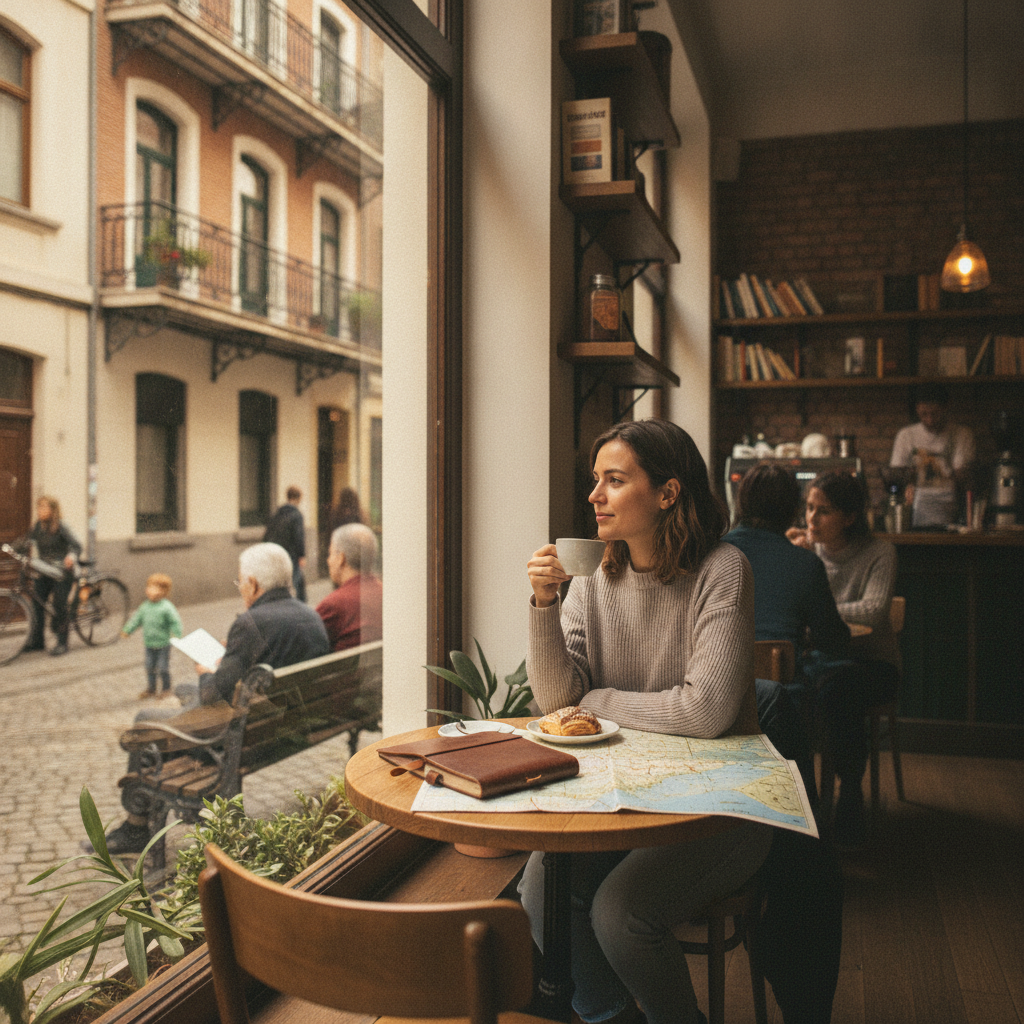
There is a particular kind of disorientation that arrives not from jet lag or unfamiliar streets, but from arriving in a new city already holding a fixed image of it. That image — assembled from travel blogs, social media, and guidebook covers — is almost always built around landmarks. The cathedral. The famous square. The viewpoint everyone photographs from the same angle. Most travellers head straight for these places on their first afternoon, and while there is nothing wrong with wanting to see them, the timing tends to work against genuine orientation. The landmarks confirm what was already known, rather than introducing what wasn't.
What a Café Teaches That a Monument Cannot
A neighbourhood café operates at a frequency that monuments simply don't. It runs on local time, serves local prices, and attracts local people who are there for the same reason they're always there — habit, comfort, and the quiet pleasure of a familiar place. Sitting inside one for an hour or two on a first afternoon does something that queuing at a famous site rarely achieves: it puts the traveller inside the rhythm of the city rather than outside it, observing. The sounds are different. The pace is different. The way the staff move and the way regulars order — without looking at a menu, with a nod or a single word — reveals something about how this culture manages its daily life that no plaque or audio guide can explain.
This matters because cultural orientation isn't primarily about information. Knowing the historical significance of a building is useful, but it doesn't help a traveller understand how people here eat, when they eat, how loudly they speak in public spaces, or what their relationship with time looks like. A café in Beyoğlu in Istanbul, or a *tasca* — a small, informal neighbourhood eatery — in Lisbon's Mouraria district, or a *kafeneion* in a quiet Athens neighbourhood communicates all of this without saying a word. The traveller absorbs it through proximity rather than instruction.
The Expectation Gap and Why It Shapes the Whole Trip
Every traveller arrives with expectations, and the gap between those expectations and reality is one of the most powerful forces shaping how a trip unfolds. When the first stop is a major landmark, that gap tends to be managed by the landmark itself — which has been designed, curated, and managed to deliver a reliable experience. The Colosseum looks like the Colosseum. It confirms the expectation rather than expanding it. This isn't a flaw in the Colosseum; it's simply the nature of iconic places. They have already been fully defined by the culture that produced them and the tourism industry that surrounds them.
A neighbourhood café, by contrast, has no such obligation. It exists for its regulars, not for visitors. Walking into one — especially in a city where the local language is unfamiliar — presents a small, manageable version of the unknown. The menu might be handwritten. The coffee might arrive differently than expected. The ambient noise might be louder or quieter than anticipated. These small surprises begin to recalibrate the traveller's mental model of the place, and that recalibration, happening gently over a single afternoon, tends to produce a more accurate and flexible sense of the city than a morning of sightseeing would.
How Slowing Down Early Accelerates Understanding Later
There is a counterintuitive logic at work here. Spending the first afternoon slowly — sitting, watching, ordering something small, perhaps attempting a phrase or two in the local language — feels like a sacrifice of time that could be spent seeing more. In practice, the opposite tends to be true. Travellers who slow down early tend to read the city more accurately for the rest of their stay. They've already calibrated to local pace and social norms, which means they make better decisions about where to eat, where to walk, and which areas feel worth exploring further.
This connects to what some long-term travellers call *sens de lieu* — a French phrase meaning a felt sense of place — which develops not from what you see but from how you inhabit a space. A café in Bangkok's Phra Khanong neighbourhood, far from the tourist circuit of Sukhumvit, introduces that sense almost immediately. The sounds of a motorbike delivery, the smell of jasmine garlands at a nearby spirit house, the particular quality of afternoon light through slatted windows — these accumulate into something that functions like spatial knowledge. By the time you leave that café, the city feels slightly less foreign, and that feeling compounds across every subsequent day.
Practical Approach to Finding the Right Café
The right neighbourhood café for this kind of first-afternoon experience is usually not the one that appears on a travel app's top-ten list. The useful markers are practical ones: a handwritten menu or specials board, a clientele that is mostly local and unhurried, seating that encourages lingering rather than quick turnover, and a location at least two or three streets removed from any major tourist site. Apps like Google Maps can be useful here, but searching by distance from the accommodation rather than by rating tends to surface the less curated options. Looking for places where the staff don't immediately switch to English is another reliable signal that you've found somewhere oriented toward its neighbourhood rather than its visitors.
Once there, the approach matters as much as the location. Ordering something small to begin with — a coffee, a local soft drink, whatever seems most common on surrounding tables — gives a reason to stay without pressure to leave quickly. Bringing a notebook or a book creates comfortable cover for extended sitting. What you are really doing, though, is observing: how the space is used, what the social dynamics look like, how formality or informality operates, and what the pace of the afternoon actually is in this city. All of this builds the quiet competence that makes the rest of the trip feel more navigated and less improvised.
By the time you step back outside and begin making your way toward wherever the evening takes you, something has shifted. The city feels less like a set of destinations waiting to be visited and more like a place that already has a life of its own — one you've briefly and genuinely been part of. That feeling, arrived at through nothing more dramatic than a chair, a drink, and an unhurried afternoon, tends to stay with you longer than any photograph of a famous skyline. It's the particular texture of a place, absorbed quietly, that makes the difference between a trip you remember and one you simply completed.