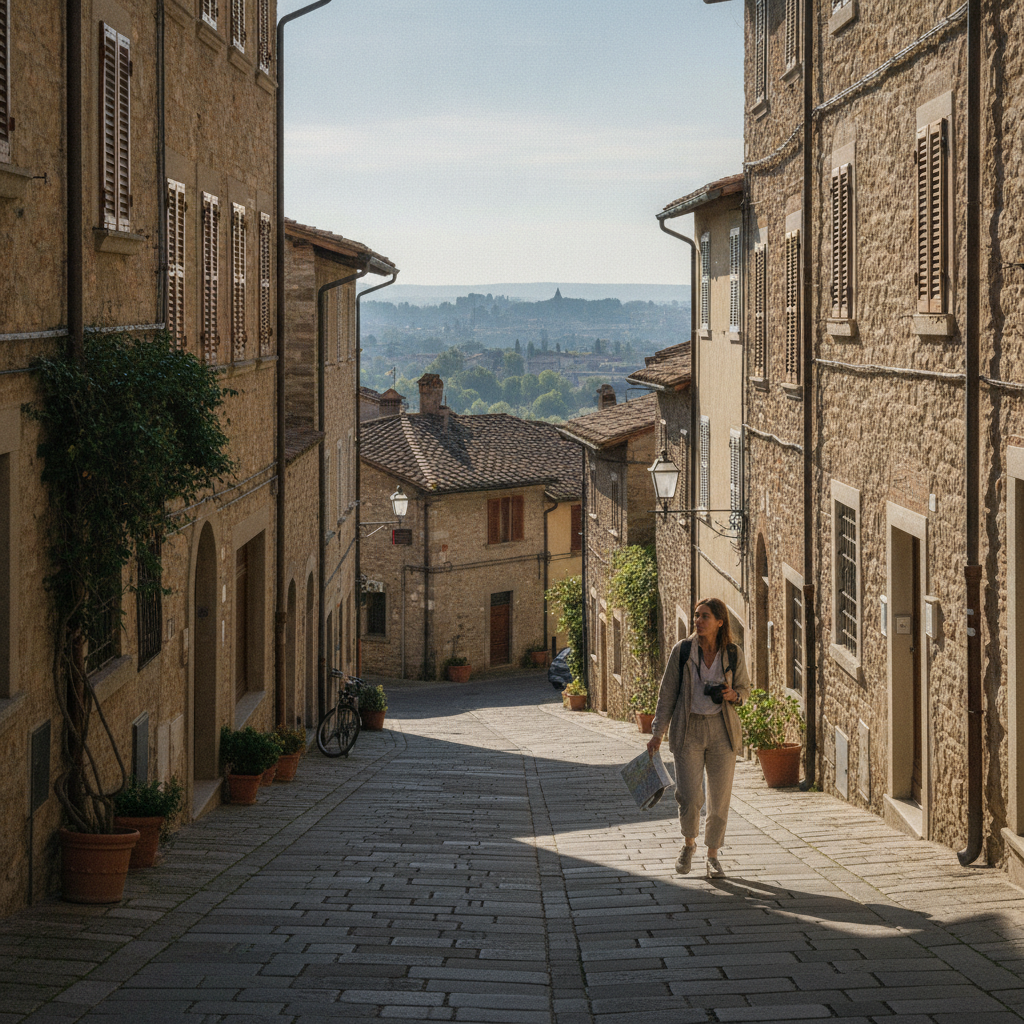
There is a particular kind of disorientation that settles in during the first hours in a new city — not unpleasant, exactly, but unsettling enough to push most travelers toward the path of least resistance. They reach for a guidebook, open Google Maps, and follow a curated trail from monument to café to viewpoint, moving efficiently but never quite landing. By evening, they've seen the highlights, ticked the landmarks, and still feel like strangers to the place. The city remains a backdrop rather than something they've actually entered.
The Geography of Arrival
The first full day of a trip carries a disproportionate weight. It sets the tone for how you read the place, how confident you feel moving through it, and how willing you are to deviate from the plan in the days that follow. Travelers who spend that day in structured, guided movement often find themselves dependent on that scaffolding for the rest of the trip — always checking, always confirming, never quite trusting their own internal map. Those who spend it walking freely through a residential neighborhood tend to develop something different: a felt sense of the city's logic, its rhythms, and its proportions that no app can transfer.
The reason is partly neurological and partly experiential. When you walk without a set destination through streets where people actually live — where laundry hangs from balconies, where corner shops open for the school run, where the smell of someone's cooking drifts through a courtyard — your brain begins constructing a genuine spatial model of the place. You're not consuming the city as a series of attractions; you're inhabiting it as a system. The difference in how you carry yourself afterward is noticeable, even if you couldn't quite articulate why.
What Residential Districts Reveal
Tourist zones, however charming, present a curated face. Residential districts present a functioning one. The streets are quieter in some ways and more revealing in others — you notice where the public transport actually runs, how far the central district really is on foot, which direction the terrain slopes, where people gather in the early afternoon. These are the coordinates that make a city legible, and they accumulate almost unconsciously when you're simply walking without an agenda. Apps like Organic Maps, which works offline and shows neighborhood-level street detail without the distraction of commercial overlays, are useful for this kind of walking precisely because they give you just enough information to stay oriented without directing you.
The key is duration. A short wander doesn't produce the same effect. A walk of three to five hours — long enough to get genuinely tired, to feel the city's scale in your legs, to find yourself somewhere unfamiliar and figure out how to return — creates a physical memory of the place that shorter excursions can't replicate. You learn the difference between how far things look on a map and how far they feel underfoot. That recalibration is exactly what makes the second and third days feel so much more manageable.
Timing the Walk for Maximum Absorption
When you go matters almost as much as where. Setting out by eight or nine in the morning on that first full day catches the city in its working mode — people heading to jobs, markets opening, cafés filling with regulars rather than visitors. The energy is unperformed. By starting early, you also give yourself the full arc of the morning and afternoon, which means you'll encounter the same streets in different light and different states of activity. A square that was quiet at nine might be full of schoolchildren by noon and reconfigured entirely by three.
Using Apps as a Light Framework, Not a Guide
The temptation to plan the walk too carefully should be resisted. The value lies specifically in the unstructured quality of it. That said, a few light tools make the experience more confident rather than more directed. Komoot is excellent for flagging a loose radius — you can set a rough distance from your accommodation and let it show you what's walkable without suggesting a specific route. AllTrails, while primarily designed for hiking, has an underappreciated urban walking function in many cities that shows paths through parks and quiet residential corridors that standard navigation tools tend to skip. The goal with any of these is orientation, not instruction.
Neighborhoods worth seeking out are almost always the ones just beyond the radius most visitors consider. In Lisbon, that might mean walking east from Alfama into Beato before the area fills up. In Porto, it could mean crossing into Campanhã rather than looping back through the riverside. These secondary residential zones lack the polish of tourist-facing districts precisely because they're meant for living in, and that's where the spatial education happens.
How One Walk Changes the Rest of the Trip
The effect of a long, purposeful residential walk on the days that follow is consistent enough to be worth planning around. Travelers who do this report a marked shift in how freely they move afterward — fewer hesitations at junctions, less compulsive checking of the phone, a greater willingness to follow something interesting without needing to verify it against a list. The spatial confidence is real, and it compounds. When you understand a city's underlying geometry — its hills, its water, its density gradients — you can trust your instincts rather than outsourcing every decision to an algorithm.
There's also a practical dimension. A long walk through a residential area surfaces things that no itinerary would surface: the bakery that opens at six and runs out by nine, the covered market three streets from your accommodation that wasn't mentioned anywhere, the tram line that cuts twenty minutes off a journey you'd been dreading. These discoveries don't feel lucky — they feel earned, because they are. You found them by being present and paying attention, not by following a pin.
The irony of modern travel tools is that the better they get at directing you, the more they diminish the sense of agency that makes travel feel meaningful. Spending your first full day walking slowly through a residential district, without a schedule and with only a loose geographic boundary, is a kind of deliberate refusal of that dynamic. It asks more of you, and it gives more back. The city you arrive in on day two is the same city it was on day one — but your relationship to it has changed entirely. That shift, quiet and cumulative, is what makes every day that follows feel less like visiting and more like being somewhere real.
If a trip is coming up in the months ahead, it's worth identifying the residential district closest to your accommodation before you leave — not to plan a route through it, but simply to know it's there and to commit to spending that first full day inside it, on foot, without a destination. That single decision tends to shape everything else that follows.