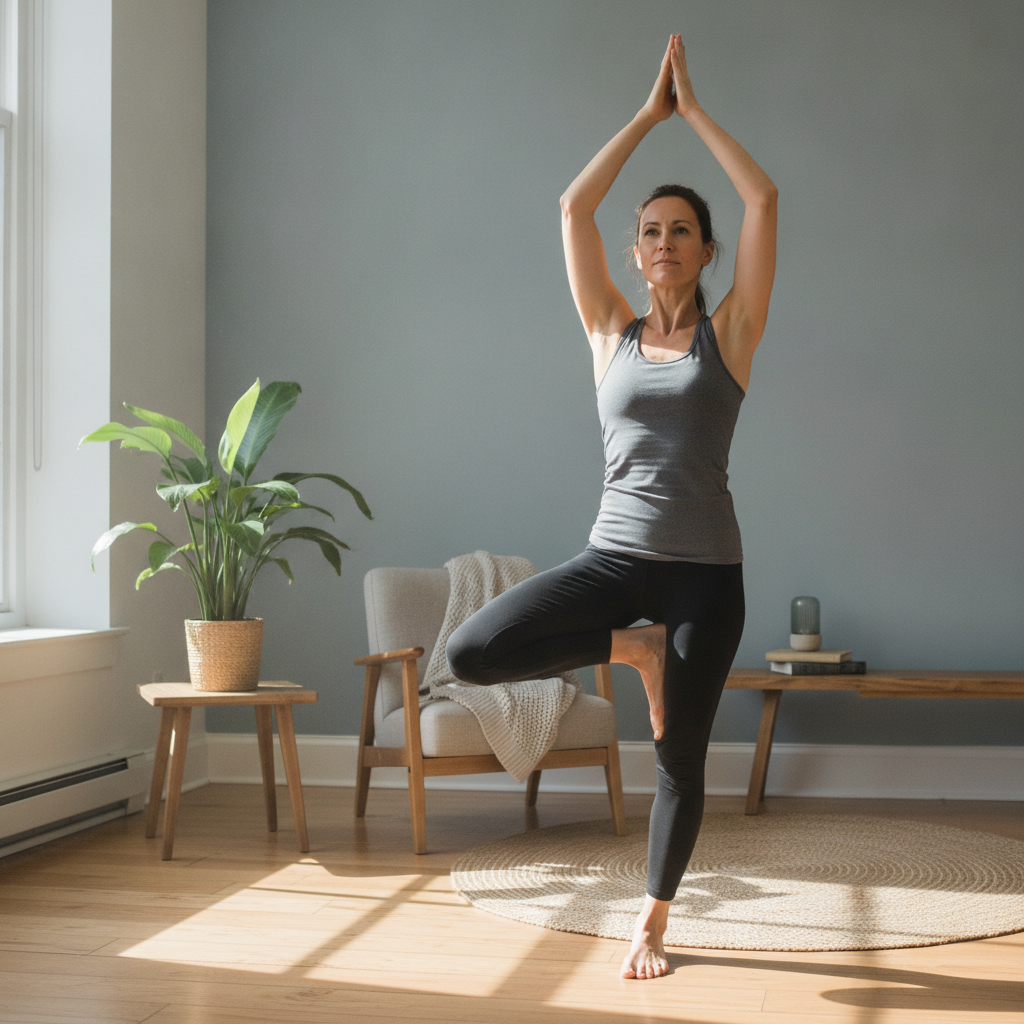
Balance is a neurological skill before it is a physical one. Most fitness routines focus on strength, endurance, or flexibility, but they rarely challenge the brain's ability to process and respond to positional information in real time. That gap matters more than most people realize — and a short daily balance practice, requiring no equipment and very little space, is one of the most efficient ways to close it.
If your workouts feel complete but you still notice occasional unsteadiness, stiffness when changing direction quickly, or a vague sense that your body doesn't respond as sharply as it once did, this is the piece that's likely missing. The nervous system needs specific input to maintain what researchers call proprioceptive acuity — the body's ability to sense its own position and self-correct in real time. Conventional gym work provides relatively little of that input.
Understand What Balance Training Actually Trains
When you hold a single-leg stance, your nervous system is doing far more work than your muscles. Signals travel from sensory receptors in your feet, ankles, and joints up through the spinal cord to the cerebellum and brainstem, which then send correction signals back down — all within milliseconds. Repeating this process regularly creates faster, more reliable neural pathways. Over time, those pathways improve postural control, reaction speed, and coordination during everyday movement, not just during formal exercise.
Start With the Single-Leg Hold on a Firm Surface
The most accessible starting point is a simple single-leg stance on a flat floor. Stand near a wall or counter for safety, lift one foot a few inches off the ground, and hold for thirty seconds per side. Keep your gaze fixed on a stationary point across the room — this gives your visual system an anchor while your vestibular and proprioceptive systems do their work. Aim for three rounds per side. The goal isn't perfect stillness; the small corrective wobbles are exactly what trains the system.
Gradually Reduce Visual Cues to Deepen the Challenge
Once a firm-surface hold feels manageable with eyes open, close your eyes for part of each hold. This removes the visual input your brain relies on most heavily, forcing your proprioceptive and vestibular systems to compensate. The difficulty increase is immediate and significant. Apps like Balance (available on iOS) or the balance assessments built into the Oura Ring's companion app can help you track progress over time if you want a reference point, though neither is necessary to benefit from the practice itself.
Introduce an Unstable Surface Once the Basics Are Solid
A folded yoga mat, a balance disc, or a BOSU ball adds surface instability that multiplies the neurological demand. The foot and ankle receptors work harder because the surface is constantly shifting, and the signals sent upward to the brain are richer and more varied. Products like the REP Fitness balance board or a standard AIREX pad are affordable options that last for years. Spend two to three weeks building consistency on a firm surface before adding instability — rushing this step often leads to poor form rather than better training.
Add a Cognitive Layer to Build Real-World Stability
The brain rarely processes balance in isolation. In daily life, you're catching a falling object, turning to answer a question, or stepping off a curb while thinking about something else entirely. Training balance under mild cognitive load — counting backward from one hundred by threes, reciting a list aloud, or passing a small object hand to hand — better approximates real-world demands. This dual-task training has shown particular promise for older adults and anyone who has experienced even minor balance disruptions from illness, injury, or sedentary periods.
Use Transition Moments as Embedded Practice Opportunities
Five minutes of deliberate practice is valuable, but balance training also fits naturally into moments that already exist in your day. Brushing your teeth, waiting for coffee to brew, or standing at a kitchen counter are all moments where a single-leg stance costs nothing extra. Researchers studying habitual movement patterns consistently find that embedding short physical challenges into existing routines produces stronger adherence than scheduling them as separate sessions. The nervous system responds to frequency as much as intensity, so these small doses compound meaningfully.
Build Toward Dynamic Balance for Full-Body Benefit
Static holds are the foundation, but dynamic balance — moving while maintaining postural control — is where the real-world payoff lives. Single-leg Romanian deadlifts, lateral step-overs onto a low platform, or slow-tempo walking lunges on an uneven surface all train balance under load and in motion. Yoga traditions have embedded these principles for centuries; practices like Iyengar yoga, in particular, place exceptional emphasis on the neurological precision of each pose. Incorporating even two or three dynamic balance movements into an existing workout routine adds measurable neurological training without requiring extra time.
Treat Consistency as the Core Metric, Not Duration
Five minutes practiced six days a week outperforms thirty minutes practiced once. The nervous system adapts through repetition and regularity, not volume. A useful approach is to anchor the practice to something that already happens reliably each morning — standing during a news briefing, practicing while a podcast plays, or pairing it with morning sunlight exposure. The specific anchor matters less than the reliability. Within four to six weeks of consistent practice, most people notice tangible improvements in how confidently and quietly they move through daily physical spaces.
Balance training is becoming a more recognized priority in preventive health conversations, and that shift is well founded. As the relationship between neurological stability, fall prevention, and long-term cognitive health becomes clearer, short daily practices like this one are likely to move from niche recommendation to standard guidance. Starting now, with just five minutes and a clear floor, puts you well ahead of where most fitness advice currently points.