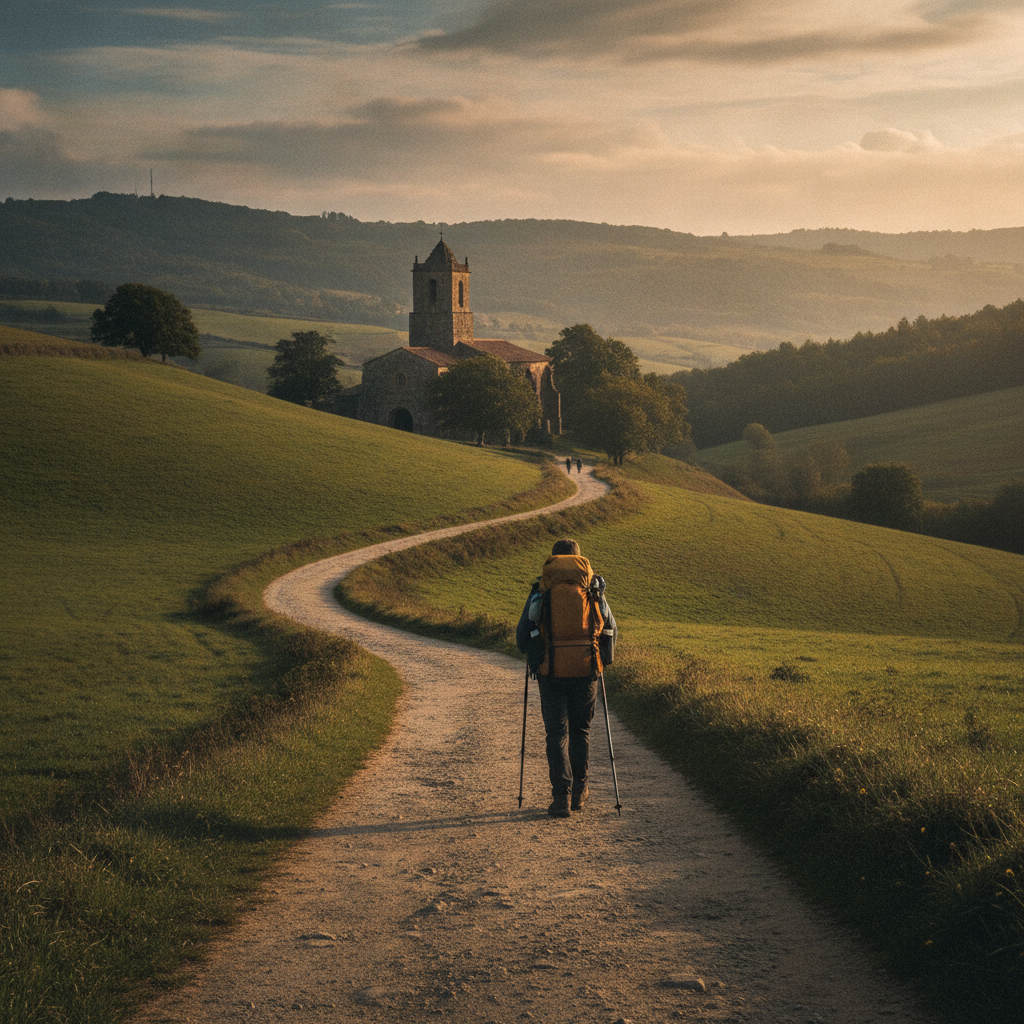
Most travel is designed around arrival — the hotel check-in, the landmark photograph, the restaurant reservation made weeks in advance. It is organized around destinations as endpoints, with transit treated as the forgettable space between. But a different tradition of travel, one that places the path itself at the center of the experience, produces something that point-to-point itineraries almost never do: a coherent emotional arc that gives a journey meaning, texture, and a sense of genuine transformation.
The Ancient Logic Behind Walking as Travel
For centuries, cultures across the world have understood that moving through a landscape on foot, over days or weeks, changes a person in ways that faster travel cannot. The Camino de Santiago in northern Spain, the Kumano Kodō in Japan, and the Lycian Way in Turkey all emerged from this understanding — that the act of sustained, purposeful walking is not merely transportation but a kind of interior work. The word *peregrino*, used for pilgrims on the Camino, carries the Latin root meaning both stranger and traveler, capturing the dual nature of someone crossing unfamiliar territory while also becoming unfamiliar to themselves. This dual transformation, physical and internal, is precisely what itinerary-based travel tends to bypass.
Why Itinerary Travel Tends to Skim the Surface
A conventional trip — four cities in ten days, hotels booked to maximize convenience, days structured around a schedule of attractions — is a legitimate and pleasurable way to see the world. But its logic is essentially curatorial, moving the traveler from highlight to highlight in the manner of a well-organized museum. What it rarely provides is continuity. Each day resets the social and emotional context: new city, new hotel, new set of logistics. Without a thread connecting these experiences, memories tend to compress into a montage rather than a story. The depth that travelers often describe feeling *after* a meaningful trip is precisely the depth that a single sustained route builds organically into its structure.
The Route as Narrative Structure
Choosing a long-distance walk as the backbone of a trip is, in essence, choosing narrative over curation. A route like the Via Francigena — the medieval pilgrim road that runs from Canterbury through the Alps and into Rome — has a beginning, a middle, and an end. Progress is measured not in cities ticked off a list but in elevation gained, blisters earned, and mornings when the body resists and the mind convinces it forward. This narrative arc means that experiences accumulate and build on each other rather than existing in isolation. A conversation with a stranger in a mountain village means more on day nine than it would have on day one, because the walker has already become someone slightly different from the person who started.
The Social Dimension of Shared Paths
One of the least discussed benefits of walking a defined long-distance route is what happens socially. The trail creates a temporary community — a moving village of strangers who happen to share a direction, a pace, and a purpose. On the Camino, this community has its own informal customs, including the practice of leaving small stones at the Cruz de Ferro, an iron cross at the route's highest point, as a symbolic act of releasing something carried from home. These shared rituals, emerging naturally from the tradition of the path rather than from a tour operator's itinerary, create the conditions for the kind of honest, unhurried human connection that most travel never quite reaches. The bonds formed on such routes are often described as disproportionately meaningful relative to their brevity.
Choosing the Right Route for Your Disposition
Not every long-distance walk demands the same traveler. Some routes, like the West Highland Way in Scotland, are logistically straightforward and can be completed in a week with relatively modest physical preparation. Others, like the Te Araroa in New Zealand — a three-thousand-kilometer trail spanning the full length of both islands — require months and a serious commitment to wilderness self-sufficiency. Between these extremes lies a wide spectrum of options suited to different temperaments, timelines, and physical capacities. The essential criterion is not difficulty but coherence: the route should be long enough to produce genuine cumulative experience, to allow the traveler to feel the difference between who they were at the start and who they are approaching the end.
What the Body Teaches That the Mind Resists
There is a specific quality of knowledge that long-distance walking produces, one that the body acquires before the mind catches up. After several consecutive days of sustained movement, the traveler begins to read terrain differently — sensing grade changes, weather shifts, and the subtle exhaustion signals that indicate when to rest rather than push. This physical attunement is a form of intelligence that modern travel rarely activates, because most travel keeps the body essentially passive. The *satori* that Zen practitioners describe — a sudden clarity that arrives without effort — is, in the reports of many long-route walkers, not unlike what happens on day five or six when the internal noise quiets and the landscape begins to speak more clearly than it did at the start.
What This Means for How You Plan Your Next Trip
If you have been searching for travel that leaves something behind rather than simply adding stamps to a passport, a long-distance walking route offers a genuinely different proposition. The planning shifts from logistics to preparation — physical conditioning, lightweight packing, an honest assessment of daily mileage — and the journey itself becomes self-organizing in a way that frees you from the decision fatigue of itinerary management. You follow the path. The path does the rest. Choose a route that matches your available time and current fitness, book only your first night's accommodation, and allow the days that follow to unfold at the pace the trail sets. The experience will be slower, harder, and considerably less comfortable than a curated city tour — and almost certainly more memorable than anything else you travel to this year.
The traveler who returns from a long-distance walk often struggles to explain what happened, not because nothing happened, but because so much of it occurred below the surface of events. This is precisely the quality that eludes itinerary-based travel, which optimizes for visible experiences while leaving the interior journey largely unaddressed. The path, by contrast, insists on both. It offers neither the comfort of a fixed schedule nor the reassurance of a known outcome — only the cumulative weight of days walked honestly, and the quiet, durable transformation that tends to follow.