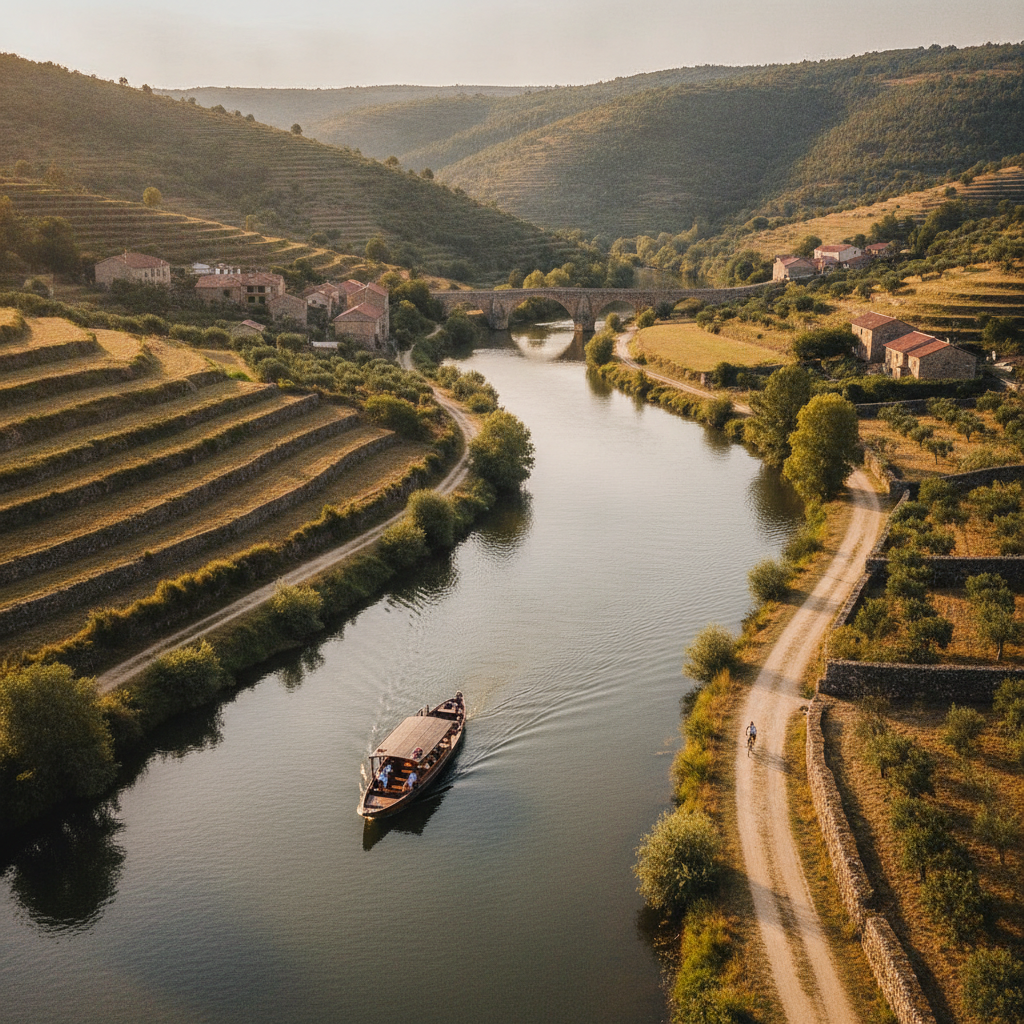
Travel has a tendency to organize itself around monuments. The instinct is nearly universal: identify the famous cities, slot them into a sequence, and connect the dots with trains or flights. The result is a journey that moves efficiently through a region without ever quite settling inside it. Something else becomes possible when the organizing principle shifts — when a river, rather than a skyline, becomes the spine of the itinerary.
Rivers have shaped human settlement for longer than any city has existed. The cultures, cuisines, agricultural rhythms, and even the temperaments of communities along a river corridor are often more closely related to each other than they are to the regional capital three hours inland. To follow a river slowly — by boat, by bicycle path, by a sequence of small-town buses — is to read the land in the direction it was always meant to be read.
What a River Route Actually Reveals
The difference between a city-to-city itinerary and a river-route itinerary isn't simply a matter of pace. It's a matter of connective tissue. Major cities distill a region's highlights into concentrated, curated form, which is genuinely useful — but that curation also flattens. The Loire Valley in France, for instance, understood as a sequence of château visits between Nantes and Blois, tells one story. Followed slowly along the actual riverbank, with overnight stays in towns like Amboise or Chaumont-sur-Loire, it tells another: of market gardeners, of small winemakers selling direct from stone cellars, of a France that is neither Parisian nor particularly interested in being photographed. The river offers a version of a region that the tourist calendar hasn't yet fully indexed.
This is partly because river towns have traditionally served each other rather than serving visitors. Commerce moved along the water before roads existed, and the social infrastructure of many river corridors still reflects that inward-facing economy. Guesthouses, ferry crossings, fishing cooperatives, riverside auberges — the French term for a modest inn offering both lodging and regional food — these are institutions built for people passing through at a human pace, not for people flying in for a weekend. The traveler who arrives by slow means tends to find these places more accessible, more affordable, and considerably more interesting than their urban equivalents.
The Rhythm That Reshapes Perception
There is a concept in Italian travel culture called *dolce far niente* — the sweetness of doing nothing — which gets cited often but rarely practiced by travelers running between museum opening hours. River travel enforces a version of it structurally. When the next stop is four hours downstream by boat, or thirty kilometers along a cycle path, the morning cannot be optimized. There is no version of the day that involves checking three landmarks off a list before lunch. The pace is set by the water and the road, not by the itinerary app.
This enforced unhurrying changes what travelers notice. The sensory texture of a journey — the smell of a regional cheese market, the sound of a lock mechanism engaging, the particular quality of afternoon light over flat agricultural land — registers more fully when the body is moving slowly enough to receive it. Experienced travelers who have done both describe the river-route version of a region as richer in detail even when it covers less geographic ground. The Danube Cycle Path, which runs from Passau in Germany through Austria and into Hungary, is often cited as a route where the riverside towns of Grein and Melk leave stronger impressions than any single day in Vienna, precisely because they're encountered gradually, in sequence, with time to absorb each one before moving to the next.
Slower Geography, Deeper Culture
River routes also tend to preserve cultural layers that cities have renovated away. Urban centers face constant commercial pressure to modernize their surfaces, which makes them exciting and sometimes homogenous. A small river town has less incentive to sand down its edges. The buildings are older, the food is more local, and the traditions — festivals tied to fishing seasons, crafts connected to the river trade, dialects that haven't merged with the capital's standard pronunciation — survive in plainer sight. In the Mekong River corridor through northern Laos, for example, the distinction between Luang Prabang and the smaller villages upstream isn't simply one of size; it's one of cultural compression versus cultural continuity. The city holds it all together for visitors; the villages live it without an audience.
This is one reason why river-route travel tends to produce more genuine exchange between visitors and residents. In a major city, the hospitality industry has developed a practiced interface with tourism — polished, functional, and at a slight remove from ordinary life. Along a river corridor, that interface is thinner. The guesthouse owner is more likely to be a farmer's relative than a trained hotelier. The dinner recommendation comes from someone who eats at the place regularly, not from a review platform. These small distinctions accumulate over several days into something that feels qualitatively different from the standard travel experience.
Planning the Route With Intention
For those considering this approach, the practical structure is simpler than it might appear. Choose a river corridor with enough linear distance to sustain three to five days of movement — the Rhine between Basel and Cologne, the Douro through Portugal's wine country, or the Murray River in South Australia all offer this. Identify two or three anchor points — larger towns that provide logistical support, transport connections, and a wider range of food and accommodation — and fill the spaces between them with smaller stops chosen for their character rather than their fame. Apps like Komoot are useful for planning cycling segments; regional rail networks often follow river valleys closely enough to serve as a reliable backup.
The key discipline is resisting the pull toward the obvious. Every regional river corridor has one or two towns that guidebooks always mention, and those towns are worth including — but not at the expense of the unmarked ones between them. The village with no tourism infrastructure of its own, reached by a local bus that runs twice a day, is often where the most enduring memory forms.
When you build a journey around water rather than around skylines, you accept a different bargain. You trade the efficiency of moving between curated highlights for the slower reward of watching a region unfold at its own pace. The monuments are still there — they're visible from the riverbank, or a short walk from the guesthouse — but they arrive in context rather than in isolation. What begins as a change in itinerary structure eventually becomes a change in how travel itself feels: less like a checklist executed and more like a place genuinely entered.