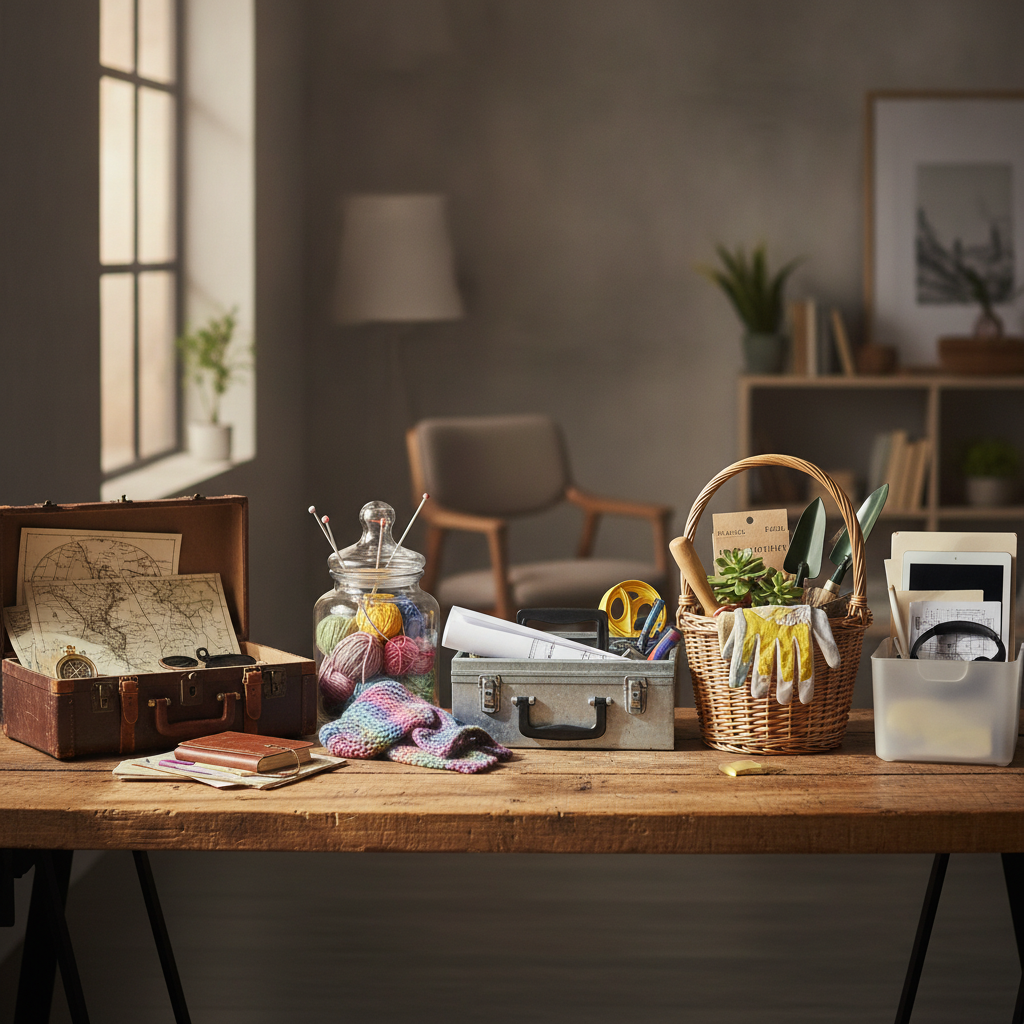
Creative momentum is fragile in a way that productivity culture rarely acknowledges. You can have a genuinely good idea, real enthusiasm, and even blocks of time set aside — and still watch a project slowly dissolve into the background noise of daily life. The reason is rarely laziness. More often, it's the invisible cost of not knowing where things live. When your half-finished screenplay exists as a loose document on your desktop, three sticky notes on the fridge, and a voice memo you haven't opened in weeks, the project doesn't feel like a project anymore. It feels like a problem.
One of the most quietly effective tools for sustaining long-term creative work is also one of the most physical: assigning each active project its own dedicated container. A box, a folder, a basket, a notebook — something you can hold. The principle sounds almost too simple, but it works for a reason that goes deeper than tidiness.
The Problem With Projects That Live Nowhere
When a project lacks a physical home, your brain takes on the job of housing it. That means a portion of your working memory is perpetually occupied with not losing track of things — which notes belong to which idea, what stage a project is at, where you left off last time. Cognitive scientists call this kind of low-level mental maintenance "open loops," and they accumulate quickly. By the time you have three or four active projects with no clear physical anchor, the mental overhead alone is enough to make creative work feel exhausting before you've even started.
What a Physical Container Actually Does for Your Brain
A container — whether it's a Muji storage box, a simple manila envelope, or a labeled IKEA tote — acts as an external memory system. When everything related to a project lives in one place, your brain stops having to track it. The object itself becomes the signal. Picking up the box tells your mind: this is the project, and everything you need is here. That transition from searching to simply beginning is where a surprising amount of creative energy gets recovered.
Choosing the Right Container for Each Type of Project
Not every project needs the same kind of container, and matching the format to the work matters. A writing project might live in a fabric-covered binder with printed drafts, sticky notes, and clippings tucked inside. A home renovation plan might belong in a flat-file folder with swatches, measurements, and contractor quotes. A creative side business could occupy a dedicated desktop tray stacked with research printouts and a single spiral-bound notebook. The goal isn't uniformity — it's specificity. When the container fits the project's texture, you're more likely to reach for it.
Keeping the Container Closed When You're Not Working
One of the underrated rules of the container method is closure — both literal and psychological. When you finish a work session, everything goes back in, and the container is put away or closed. This isn't about neatness for its own sake. It's about containing the project's mental presence. A project that's physically closed isn't asking for your attention when you're supposed to be cooking dinner or sleeping. The boundary the container creates is one of the fastest ways to prevent the low-grade anxiety that comes from feeling like everything is simultaneously unfinished.
Limiting How Many Containers Are Active at Once
The container method only works as a momentum tool if you apply a limit. Having twelve open projects in twelve labeled boxes doesn't solve sprawl — it just makes it more colorful. A practical ceiling for most people is three to five active containers at any given time. This forces genuine prioritization. If a new idea arrives and you're already at capacity, the container principle creates a healthy constraint: something needs to close before something new opens. That friction is productive. It keeps you honest about what you're actually pursuing versus what you're just collecting.
Using the Container as a Re-Entry Point After Breaks
One of the most common creative killers is the gap — the week you didn't work on something because life intervened. Re-entry after a break is where projects most often die permanently, because the cost of reconstructing context feels too high. A physical container almost entirely eliminates that cost. Opening the box and spending two minutes reviewing what's inside is usually enough to restore where you were. Tools like a Leuchtturm1917 notebook kept inside the container — with a running log of last session's progress — make re-entry a two-minute ritual rather than a thirty-minute reconstruction.
Archiving Finished Projects to Mark Real Completion
The transition from "active" to "finished" deserves a physical gesture, and the container method provides one. When a project is genuinely complete, move its container to a designated archive shelf or storage area — somewhere separate from your active workspace. This act of physical relocation does something that digital completion rarely achieves: it signals to your nervous system that the loop is closed. Neighborhoods like the creative quarters in cities like Porto or Lisbon are full of studios where finished work gets physically stacked or filed away, making space — literally and mentally — for what comes next.
Reviewing Your Active Containers on a Weekly Rhythm
Once a week, spend ten minutes with your active containers. Not working on them — just reviewing. Is this still a genuine priority? Does anything need to be added before the next session? Has a container been untouched for too long? This brief check-in keeps the system honest. It prevents the slow drift where a container becomes a guilt object rather than a working tool. Think of it as a light editorial pass on your own creative commitments — a moment to confirm that what you're holding space for is still worth the space.
The core idea here is that the mind needs physical anchors to sustain creative work across time. A project without a container is a project that depends entirely on willpower and memory — two unreliable resources. Give each active pursuit a dedicated home, keep that home bounded, and the mental sprawl that quietly erodes momentum has far less room to take hold. The work doesn't get easier, but the friction of returning to it does.