There is a particular kind of knowledge that only comes from sitting at a table where you don't entirely understand what's in front of you. A steaming bowl arrives, and the person who placed it down offers a word — one that doesn't translate cleanly into English — and suddenly the whole purpose of the journey sharpens into focus. Food, more than monuments or museums, carries the memory of a place inside it. It holds geography, climate, migration, agriculture, and social hierarchy in a single dish, often without announcing any of it. Travelers who build entire trips around a single regional food tradition consistently find that they return home with something no curated highlight reel could provide: a working understanding of how people actually live.
What a Food Tradition Actually Encodes
Regional cuisines are not simply collections of recipes. They are living archives of adaptation — evidence of what grew nearby, what was preserved through winters, what arrived with traders or colonizers, and what was stubbornly maintained through cultural rupture. The mole negro of Oaxaca, for instance, is not merely a sauce; it represents centuries of indigenous Zapotec cooking layered with colonial-era Spanish influence, the result of specific chilies that grow only in certain microclimates of southern Mexico. A traveler who spends a week in Oaxaca specifically to understand mole — visiting the Mercado Benito Juárez, watching it ground on a metate, learning why chocolate entered the recipe and when — absorbs a kind of regional history that no walking tour delivers. The food becomes a lens through which everything else comes into focus: the land, the labor, the pride.
This depth of context doesn't happen by accident. It requires choosing a tradition deliberately before departure — researching its geography, its seasonal logic, and its social role. Some traditions are tied to specific celebrations, such as the biryani customs of Hyderabad in India, where the dum method of slow-cooking rice and meat in a sealed vessel reflects both Mughal court influence and the practicalities of feeding large gatherings. Others are bound to specific landscapes, like the charcuterie culture of the Périgord region in southwestern France, where the prevalence of black truffles, duck, and walnut oil tells the story of a farming economy that depended on preservation and on making use of every part of an animal. Understanding these origins before arriving means every meal becomes a confirmation of something learned, rather than just a pleasant interruption between sights.
How the Itinerary Changes When Food Leads
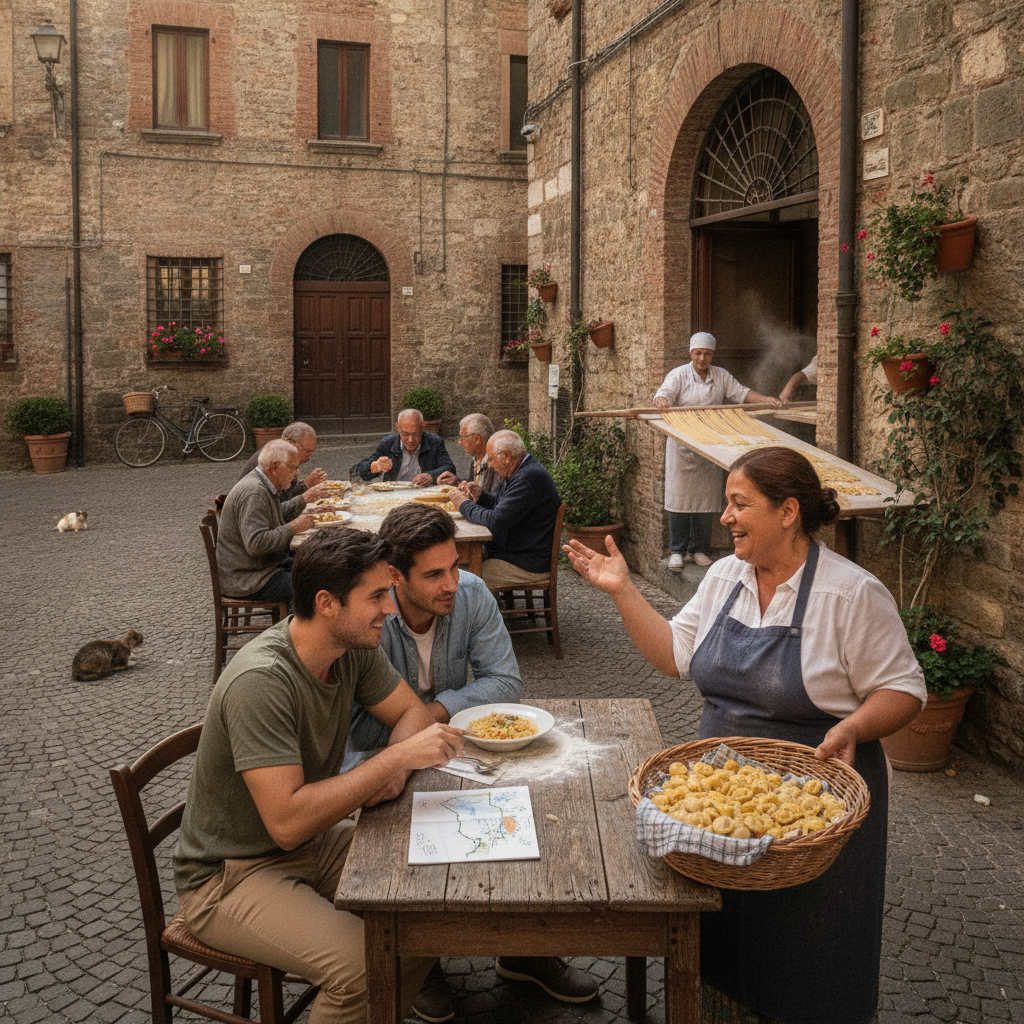
Building a trip around a food tradition fundamentally reorganizes the itinerary in ways that favor depth over coverage. The usual impulse to check off major landmarks gives way to a different kind of map — one plotted around markets, specific neighborhoods, particular villages, and the producers who make the tradition possible. A traveler following the *pintxos* culture of San Sebastián in the Basque Country of northern Spain won't simply bar-hop through the Parte Vieja; they'll eventually find themselves in conversation with a fisherman about the anchovy season, or watching a grandmother assemble a gilda — the classic skewer of olive, anchovy, and pickled pepper — with the ease of someone who has never needed to think about it. These moments happen naturally when the food itself is the organizing principle.
The pace also shifts. Food-led travel tends to be slower and more localized, which has the secondary benefit of reducing costs. Rather than moving between three cities in five days, a traveler stays longer in one region, eats where locals eat rather than where tourists are directed, and develops enough familiarity with a place that its rhythms become readable. The early morning fish market, the afternoon lull when everything closes, the evening gathering in the town square — all of these become part of a daily texture rather than background noise. Apps like TheFork help with reservations in cities where spontaneous entry to the right restaurant is unlikely, but the most valuable meals are often found without any technology at all, simply by following the smell of something cooking through a narrow street.
The Vocabulary That Opens Doors
Learning even a small number of food-related terms in the local language produces a disproportionate return in human connection. These words — *mise en place*, *umami*, *sofrito*, *roux*, *banchan* — carry cultural weight far beyond their culinary definitions. Banchan, the collective term for the small side dishes served alongside rice in Korean cuisine, reflects a philosophy of communal eating and balance that shapes the entire structure of a Korean meal. Walking into a restaurant in Jeonju, the city widely regarded as South Korea's food capital, and asking about the specific banchan of the region signals something to the cook that no amount of enthusiastic pointing can convey. It says: this person has made an effort to understand, not just to consume.
This effort, however modest, tends to be reciprocated generously. Hosts and cooks who sense genuine curiosity rather than passive tourism often go further — explaining techniques, recommending producers, describing how a dish changes between valleys or seasons. The exchange moves from transaction to conversation, and from conversation to the kind of insight that only one person can offer another. Guidebooks, however well-researched, cannot replicate that. They describe what is generally true; a local tells you what is specifically true right now, in this season, in this kitchen.
Returning With Something That Lasts
When you return from a trip organized around a single food tradition, the experience doesn't close the way a list of sights does. A checked landmark fades into a photograph. A food tradition you've genuinely pursued stays active — in the market habits you bring back, the ingredient you seek out at home, the memory of a particular flavor that surfaces unexpectedly months later. The understanding gained through eating is embodied in a way that reading never quite achieves.
That bowl placed in front of you at the beginning, with the word you didn't yet know — by the end of a trip like this, you know it. You know why the dish is made this way, who made it first, and what it meant to them. That, more than any itinerary filled with famous addresses, is what travel at its best produces: not just the experience of having been somewhere, but the quiet certainty of having understood something.