There is a particular kind of restlessness that settles in after a pleasant but unmemorable evening with friends — the wine was good, the conversation circled familiar territory, and everyone drove home feeling vaguely satisfied but not quite nourished. Social gatherings, for all their warmth, can drift toward a comfortable sameness that, over time, leaves relationships pleasantly maintained rather than meaningfully deepened. The format itself shapes what's possible between people, and when the format rarely changes, neither do the connections.
The Architecture of a Skill-Swap Dinner
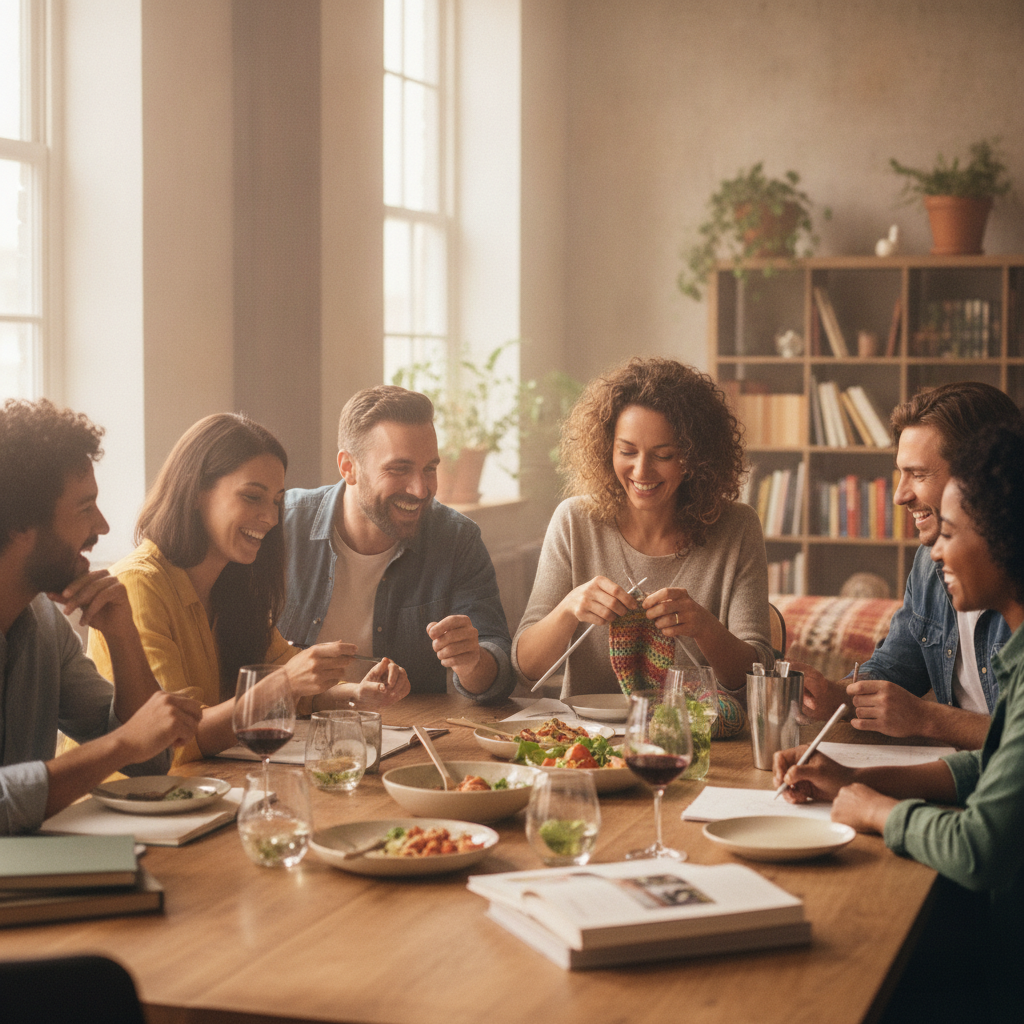
A skill-swap dinner operates on a simple but surprisingly powerful premise: each guest arrives prepared to teach something, and everyone leaves having learned something. The teaching needn't be elaborate. One person might demonstrate a knife technique borrowed from a month spent in Lyon. Another walks the group through the fundamentals of sourdough fermentation, explaining why hydration ratios matter. A third shares the Japanese concept of *wabi-sabi* — the art of finding beauty in imperfection — as a lens for arranging a simple centerpiece from foraged materials. The dinner itself becomes the classroom, the kitchen counter doubles as a workshop, and the meal that emerges is a collaborative artifact of everyone's contribution. This structure, repeated monthly or seasonally, creates what anthropologists might call a *ritual frame* — a shared, recurring context that signals to participants that this time together holds distinct meaning.
What distinguishes this format from a standard dinner party is not merely the activity but the quality of presence it demands. When someone is preparing to teach, they've thought carefully about what they know and how to communicate it. That act of preparation is itself a form of vulnerability — it requires owning one's knowledge publicly, risking imprecision, and trusting that the group is a safe enough space for that kind of exposure. Vulnerability, as a relational currency, generates intimacy far more efficiently than small talk, no matter how warm.
Why Reciprocal Teaching Accelerates Intimacy
Social psychology has long recognized that mutual disclosure — the back-and-forth of revealing something real about oneself — is one of the most reliable accelerants of genuine closeness. Teaching a skill is a form of disclosure that operates on multiple levels simultaneously. It reveals what a person values, how they think, where their curiosity has led them, and how they relate to the people in the room. A friend who demonstrates the West African practice of *ubuntu* cooking — communal preparation where the act of cooking together is as central as the meal itself — is sharing not just a technique but a philosophy of interdependence. These layers of meaning, embedded in practical instruction, create shared references that a group carries forward long after the evening ends.
Regularity compounds this effect. When the same group gathers monthly around a consistent format, each session builds on the accumulated vocabulary of previous ones. An inside reference to the disastrous knife skills demonstration from three months ago becomes part of the group's shared language. Shared language is the connective tissue of lasting relationships, and it tends to develop fastest when people have moved through an experience together — particularly one that involved a degree of uncertainty or playful risk. The recurring dinner provides exactly that texture of shared history.
The Meal as Medium, Not Just Backdrop
Food has always held a particular place in human bonding — the table is one of the oldest and most universal sites of community. What the skill-swap format does is restore intentionality to the meal that can erode in more passive social contexts. When a group gathers at a restaurant like Chez Panisse or a carefully chosen spot in a city's Marais district, the food arrives as a finished product, and the relationship between people and their meal is one of consumption. There is pleasure in that, certainly. But when the group has collectively produced the meal — one person making the stock, another folding dumplings using a technique just learned, a third adjusting seasoning based on a tip shared twenty minutes earlier — the food carries the fingerprints of the evening itself. Eating it becomes a kind of celebration of what the group has just done together.
This transforms the sensory experience of the meal into an anchor for memory. Neuroscience has consistently linked food, smell, and shared effort to some of the most durable forms of autobiographical memory. Years later, a particular flavor or technique can surface the entire atmosphere of an evening — the laughter over a collapsed tart, the satisfaction of a sauce that finally came together. Those sensory memories bind people to one another in ways that conversations alone rarely achieve.
Building a Format That Sustains Itself
For the skill-swap dinner to endure beyond two or three enthusiastic outings, the format needs a light but consistent structure. A rotating host keeps responsibility distributed and prevents any single person from bearing the logistical weight that leads to quiet resentment. A loose theme — fermentation one month, textiles or natural dyeing the next, basic woodworking the month after — gives participants a direction without constraining creativity. Apps like Partiful or a simple shared calendar work well for coordination without the friction of long group threads. The teaching portion needn't exceed thirty minutes; the goal is a shared experience, not a masterclass.
What matters most is protecting the recurring nature of the gathering. When the interval is fixed and the expectation is clear, attendance becomes a commitment rather than a favour, and that shift in framing changes how seriously people invest. A group that has gathered reliably for a year has built something genuinely rare: a structure for friendship that doesn't depend on spontaneity alone.
You don't need a large circle or an impressive skill set to begin. Choose three or four people whose company you genuinely value. Ask each one to come prepared to teach something they know — however modest — and make a meal around it together. The first evening will likely feel slightly awkward and slightly revelatory in equal measure. That combination is exactly where meaningful connection tends to begin. The table that once held pleasant, forgettable evenings will gradually become the site of a shared history — one built not on proximity alone, but on the quiet, generous act of offering what you know and receiving what others bring.