The idea that a single, permanent workspace is the gold standard of home productivity has shaped how millions of people set up their homes — but the reality of sustained focus tells a more complicated story.
The Psychology Behind Environmental Cues and Attention
The human brain is remarkably sensitive to its surroundings. Over time, a fixed workspace accumulates associations — the pressure of unfinished tasks, the posture of a difficult afternoon, the low-grade visual clutter of the same four walls. Cognitive research consistently points to environmental novelty as a driver of renewed attention. When a person moves to a different room, the brain undergoes a subtle recalibration, processing new light levels, ambient sounds, and spatial proportions. That recalibration, brief as it is, tends to reset mental alertness in ways that a short break in the same room rarely achieves.
How Monotony Erodes Concentration Over Time
Committing exclusively to one desk creates what might be called attention fatigue by association. The dedicated home office, over weeks and months, begins to feel less like a productive zone and more like an obligation. The chair, the view, the exact angle of the monitor — all of it becomes so familiar that the brain stops engaging with the environment at all. This is a problem because mild environmental engagement actually supports focus rather than distracting from it. A subtle shift in surroundings keeps a layer of the brain lightly stimulated, which paradoxically helps deeper concentration on the task at hand.
Matching the Room to the Type of Work
One of the more practical advantages of room rotation is the ability to align physical spaces with cognitive demands. Deep analytical work — drafting reports, working through complex problems — often benefits from quieter, more contained environments like a bedroom or a study nook. Creative tasks, on the other hand, tend to breathe better in spaces with more ambient life: a kitchen table near a window, a living room with natural light shifting through the afternoon. Apps like Notion or Todoist can help organize task types into blocks, making it easier to intentionally match the day's work to the right room before the session begins.
The Role of Light and Spatial Proportion in Mental Output
Environmental psychology has long documented the effect of light on cognitive performance. A south-facing living room in the early morning delivers a very different quality of alertness than a north-facing bedroom at midday. Room rotation allows workers to follow light throughout the day rather than sitting beneath the same fixed ceiling lamp for eight hours. Spatial proportion also plays a quieter role — smaller rooms can create a sense of containment that suits focused, solitary work, while more open spaces encourage looser, generative thinking. Neither is universally better; the key is using both deliberately rather than defaulting to one indefinitely.
Common Objections and Practical Workarounds
The most frequent resistance to room rotation centers on equipment. A second monitor, a docking station, a standing desk — these investments anchor people to a fixed location, and reasonably so. But the case for rotation doesn't require abandoning ergonomic tools entirely. A laptop paired with a portable stand and a compact Bluetooth keyboard from Logitech, for instance, creates a mobile setup that can function comfortably across multiple rooms without sacrificing posture. Noise-canceling earbuds like those from Sony or Bose handle acoustic variability. The friction of moving between spaces, once a system is in place, tends to be lower than most people expect.
Building a Personal Room Rotation Practice
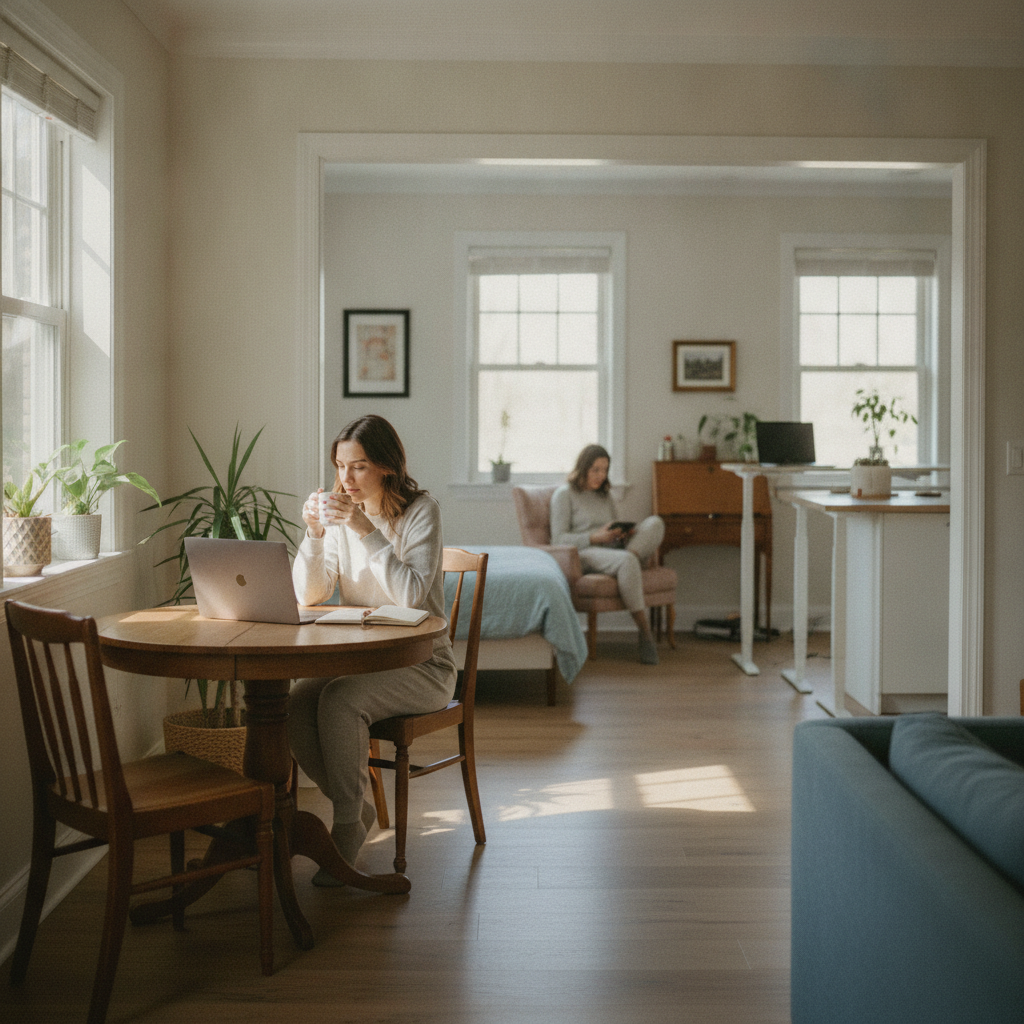
Starting a room rotation habit doesn't require a large home or a complex system. The approach works in apartments and modest houses just as well as in larger spaces, because the benefit comes from change itself, not from the size of the alternative room. A useful starting point is to identify two or three spots in the home that already receive natural light at different points in the day. From there, you can begin loosely assigning task categories to each location — detailed work at the desk, calls in the kitchen, reading or lighter tasks on the sofa. Give yourself a week to experiment without judgment, adjusting based on what felt sharpest and what felt scattered. Over time, the pattern tends to stabilize naturally, and the rotation becomes less of a deliberate choice and more of an intuitive rhythm that the day organizes itself around. Tools like the Focus app or even a simple analog timer can help anchor sessions to specific spaces without over-engineering the process.
The fixed home desk remains a useful anchor — a place to store equipment, begin the morning, and close the day. But treating it as the only legitimate place to work is a habit built more on habit than on how attention actually functions. Rotating between rooms, even modestly, returns a degree of environmental agency that sustains energy across the workday in ways that rearranging the same desk never quite can.