There is a particular kind of travel intelligence that no guidebook quite prepares you for — the kind that comes not from following a route or ticking off monuments, but from sitting still long enough to watch a place breathe. Most travelers never find it, not because it's elusive, but because it requires stepping off the path entirely and into somewhere that wasn't designed for them at all.
What a Public Library Actually Is in Its City
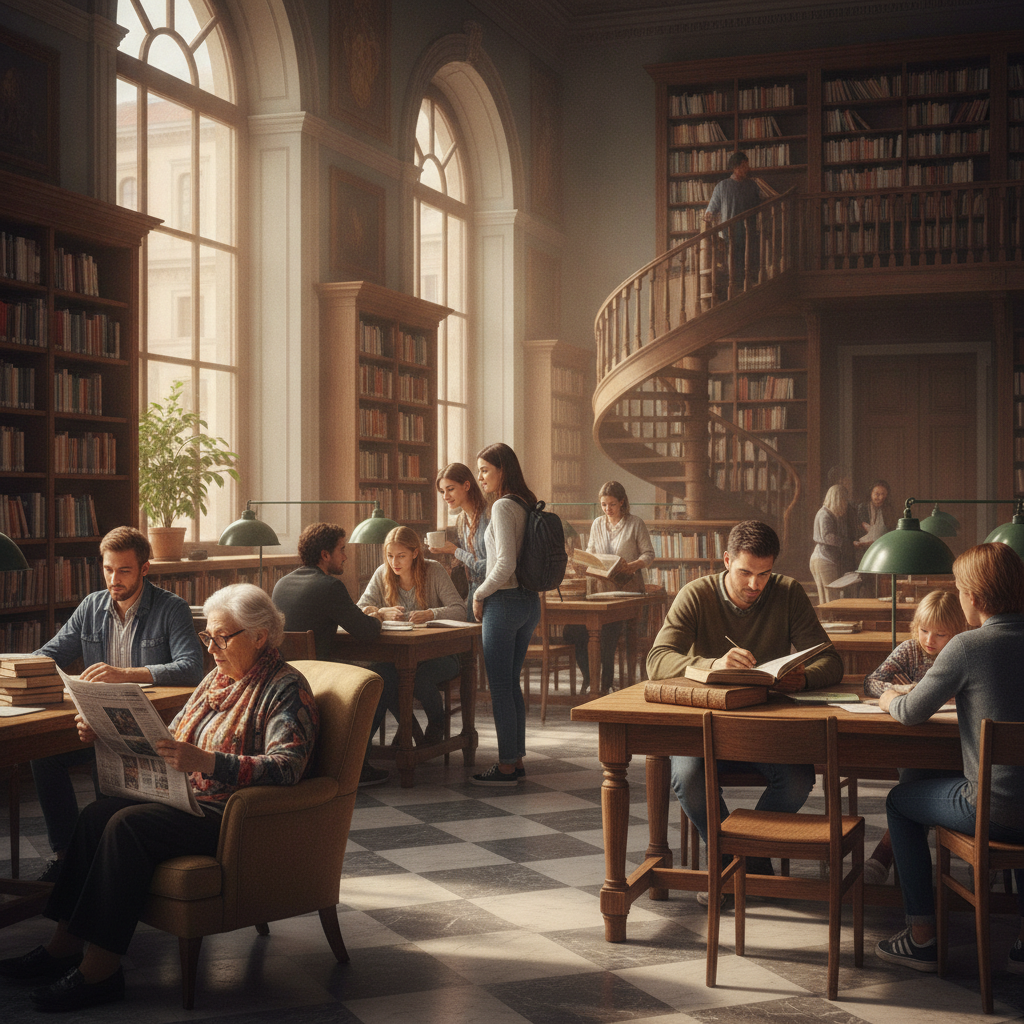
A city's public library is not an attraction. It has no entrance fee, no curated narrative, no staff trained to make visitors feel welcome in the way a museum does. It is a civic institution built for residents — for the student who needs a quiet desk, the elderly man who reads three newspapers before noon, the mother helping her child choose a picture book in a language that might be Portuguese or Catalan or Slovenian. When a traveler walks into that space, they are not a guest being accommodated. They are simply present, and that distinction changes everything about what becomes visible. The Biblioteca de Catalunya in Barcelona or the Helsinki City Library Oodi, for instance, are not designed to impress visitors — they are designed to serve communities, and the difference shows in every corner of how people use them.
The Social Architecture of an Ordinary Weekday Afternoon
An afternoon in a public library is, in the most literal sense, a cross-section of a place's daily social fabric. Unlike a market or a café — both of which have their own value as windows into local life — a library does not require anyone to spend money to be there. The range of people who inhabit the space reflects that openness in ways that commercial environments cannot replicate. Teenagers occupy the same row of tables as retired professionals. Newcomers to the city sit beside families who have lived in the neighborhood for generations. The unspoken rhythms of who sits where, how loudly people speak, whether shoes come off at the door, and how library staff interact with their regulars all carry genuine ethnographic weight — far more, in many cases, than anything a walking tour script can convey.
Reading the Collection as a Cultural Document
The shelves themselves are a form of local knowledge. A public library's collection is shaped by what the community has requested, what local publishers have donated, which languages appear in the children's section, and what topics dominate the periodical rack. In a city with a significant migrant population, this tends to be immediately visible — multilingual signage, dual-language editions, community notice boards in half a dozen scripts. In smaller regional cities, the local history section often tells a story of civic pride and contested memory that no official tour would frame in quite the same way. The *bibliothèque municipale* in Lyon, for example, holds a local history archive that reflects the city's silk-weaving past far more specifically than any guided tour of the old town. These are not curated narratives; they are accumulated ones, shaped by decades of community use.
Slowness as the Actual Point
There is something about the library's ambient pace that recalibrates a traveler's relationship with a place. The expectation to move quickly — from site to site, from photograph to photograph — dissolves in a room where the social contract requires quiet and stillness. What replaces it is attention: to details that would otherwise pass unnoticed, to the particular light coming through a specific kind of window, to the texture of the building itself. Many of the world's great public libraries occupy architecturally significant structures — the *sala de lectura*, or reading room, of various European civic libraries often reflects the political ambitions of the era that built them — but the buildings earn their meaning in context, watched from a chair rather than photographed from a doorway.
What You Actually Learn That a Tour Doesn't Teach
Guided tours are not without value — they compress expertise and provide narrative structure that independent exploration often lacks. But they are also, by design, shaped by what the tour operator believes visitors want to know. A public library offers no such mediation. The information available there — the local newspaper left open on a reading table, the community event flyers pinned near the entrance, the genre fiction section that reveals what residents read for pleasure rather than for cultural credit — is information in its raw form, unedited for an outside audience. Spending time there gives a traveler access to the texture of ordinary life: not its highlights, not its self-presentation, but the shape of its everyday. Cities like Porto, Vilnius, and Thessaloniki each have public libraries that sit at the center of their civic identity, and each rewards unhurried attention in a way that a two-hour walking tour simply cannot replicate.
How to Actually Spend the Time
If you find yourself with a free afternoon in an unfamiliar city, consider this: walk to the central public library without an agenda. Sit down. Look at the people around you. Pick up a local magazine even if you can't read it — the advertisements, the layout, the photographs will tell you something. Read the community notice board. Watch who comes and goes at the front desk. If the library has a café or a reading garden, spend time there too. The point is not to extract information efficiently but to be present in a space that was built for the people who live there, and to let that presence teach you something that structured tourism, however well-designed, tends to paper over. After an hour, the city outside will look slightly different — not because it has changed, but because your frame for it has.
The traveler who sits in a public library for an afternoon carries something home that resists the usual reduction to highlights and recommendations. It is not a story about what they saw but about what they understood — that a city is not its monuments but its inhabitants, and that the clearest window into those inhabitants is often found not in the places built for visitors, but in the ones built for everyone else.