There is a particular kind of travel frustration that only surfaces after you've returned home — the sense that what you experienced could have been experienced by anyone, at any time, in any order. You visited the monument, took the photograph, checked the box. The landmark was exactly where the map said it would be, exactly as impressive as the reviews described, and somehow, exactly forgettable. That feeling isn't a failure of imagination. It's the natural result of building a trip around something permanent, something that will look identical next month, next year, or a decade from now regardless of when you show up.
Build Your Trip Around What Won't Wait for You
When you reverse the logic — when you start with a phenomenon that exists only within a narrow window of time and then build everything else around it — something fundamental shifts in how the journey feels and what it produces. Seasonal natural events are inherently unrepeatable in the sense that each occurrence has its own character, shaped by the specific conditions of that year, that week, that moment. The cherry blossoms along the Philosopher's Path in Kyoto don't bloom on a fixed calendar date. They respond to temperature patterns, rainfall, and the particular rhythm of the season unfolding in real time. That responsiveness is precisely what makes the experience irreplaceable.
The practical implication is that you can't book this kind of trip the way you'd book a city break. You're not anchoring to a hotel's availability or a museum's opening hours — you're anchoring to a biological or meteorological event that doesn't negotiate. Apps like Bloom Watch and platforms like Windy have made it significantly more practical to track real-time natural conditions before and during a trip, giving you a meaningful edge in timing your arrival. You begin watching weeks or even months out, adjusting your window as the data sharpens, and the act of monitoring itself starts to build a relationship with the place before you've even packed a bag.
Let the Phenomenon Shape the Entire Structure of the Trip
Once you've committed to a seasonal event as the anchor, the rest of your planning takes on a different quality. Instead of reverse-engineering an itinerary from a list of attractions, you're asking a more interesting set of questions: Where do locals position themselves to witness this? What time of day does the light interact with it most dramatically? What's happening in the surrounding region that complements rather than competes with the main event? These questions lead you away from the tourist infrastructure that exists to serve the permanent landmark, and toward a quieter, more layered version of the destination.
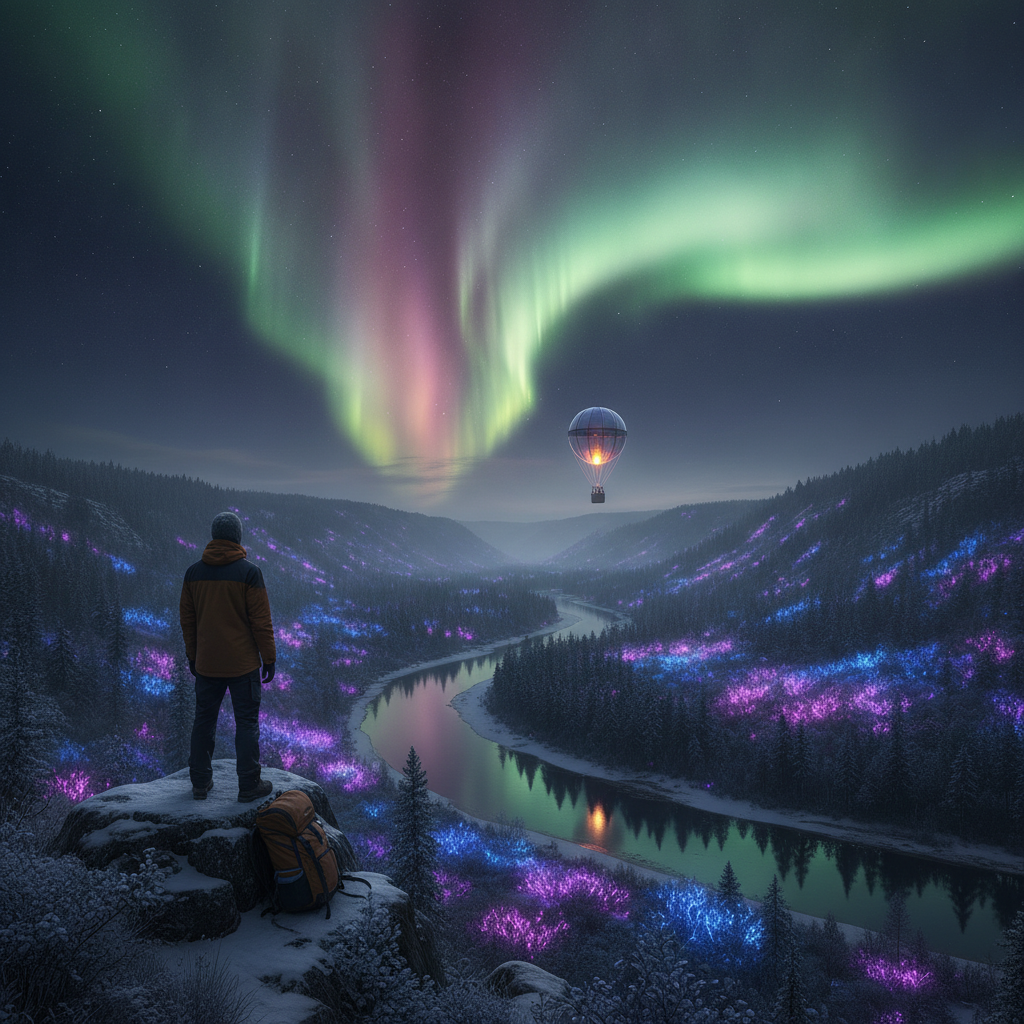
If your trip centers on the wildebeest migration across the Maasai Mara, the specific crossing points shift daily and the drama of any given morning is entirely unpredicted. If you're timing a trip to witness the northern lights along Norway's Tromsø coast, cloud cover and solar activity turn every evening into something genuinely uncertain. That uncertainty, far from being a drawback, is exactly what forces a kind of presence that fixed-landmark tourism rarely demands. You can't be on your phone waiting for the scheduled event to begin because the event doesn't have a schedule. You have to be there, attentive, watching.
Planning tools like iNaturalist and the migration tracking features within Google Earth Pro allow you to research historical patterns with enough specificity to make intelligent timing decisions without eliminating the spontaneity that makes the experience feel alive. You're informed, not over-engineered.
Timing Your Arrival Is the Single Most Important Decision You'll Make
The margin between peak and past-peak in a natural seasonal event can be measured in days, sometimes hours. Arriving a week early to a firefly bloom in the Great Smoky Mountains means you're watching a quiet forest. Arriving a week late means the same. Arriving during the three-to-five-day window when synchronous fireflies perform their extraordinary coordinated light display means you're standing inside something that most people who visit that park in a lifetime never witness. The difference isn't how far you traveled or how much you spent — it's entirely when you chose to go.
This is where building flexibility into your schedule pays disproportionate returns. Booking travel that allows you to shift your core days by two or three in either direction, even at a slightly higher accommodation cost, is a far wiser investment than arriving on a fixed date that happens to fall outside the optimal window. Following naturalist forums, regional park service updates, and community reports via platforms like iNaturalist gives you real-time ground-truth information that no travel guidebook published before your trip can provide. The people who were there yesterday, reporting what they saw, are your most reliable data source.
It also matters deeply where you position yourself relative to the phenomenon. The light on the Antelope Canyon slot canyons reaches its most dramatic vertical shafts in the hours around midday during late spring and early summer — arrive in November and the beams don't appear at all. Understand the mechanics of what you're trying to witness, and let that understanding dictate not just when you arrive, but where you stand and what hour you wake up.
What You Carry Home Is Genuinely Yours
A trip built around a seasonal natural phenomenon produces something that photographs and itineraries can't fully transmit to someone else: the memory is conditionally yours. The specific bloom density, the particular color temperature of a winter aurora, the crossing behavior of animals responding to that season's rainfall — these are conditions that will never repeat in exactly the same configuration. When you tell someone about this trip, you're not describing something they could simply replicate by booking the same hotel. You're describing a convergence of timing, attention, and presence that was specific to you and to that window in time.
As real-time ecological monitoring tools become more sophisticated and more accessible to independent travelers, the ability to plan around natural phenomena is only going to deepen. Predictive models for bloom seasons, animal movement, and atmospheric events are growing more precise, which means that the gap between informed timing and guesswork is narrowing in your favor. The traveler who starts watching seasonal data months before departure, who builds in scheduling flexibility and follows ground-level community reports, is increasingly well-equipped to arrive exactly when a place is doing something it won't do again quite the same way. That's the trip worth planning for — and there's no reason to wait until next year to start watching.