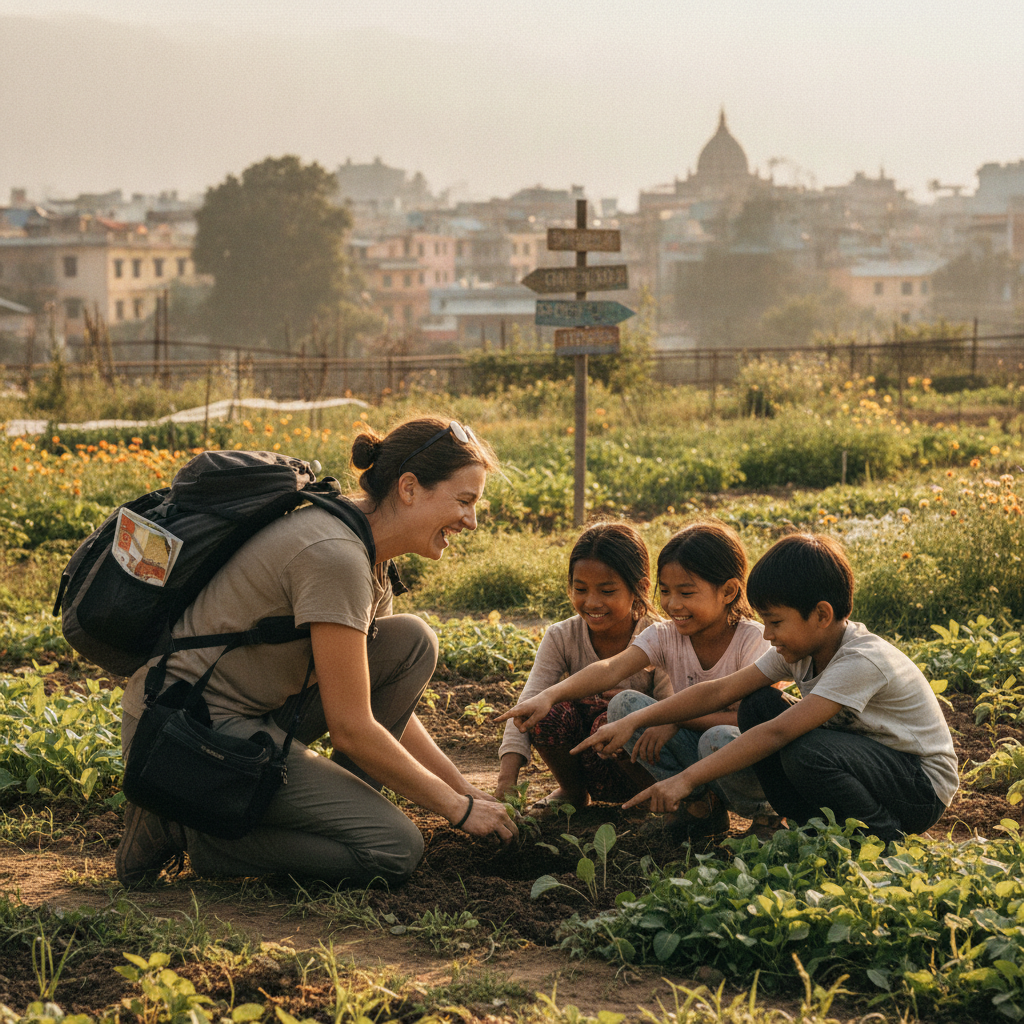
Travel has a curious way of flattening experience. The more carefully a trip is planned, the more it tends to confirm what the traveler already expected — the famous square looks exactly like the photograph, the recommended restaurant delivers exactly the described dish, the walking tour ends exactly where the map said it would. There is comfort in this, but also a kind of quiet disappointment. Something was witnessed, nothing was truly encountered.
The traveler who gives half a day to a local organization — a community garden, a food bank, a neighborhood literacy program — discovers something that no guidebook can manufacture: the feeling of being useful somewhere unfamiliar. That shift is small in hours but enormous in effect. The rest of the trip does not simply continue; it reorganizes around a new center of gravity.
What Breaks Open When You Stop Being a Visitor
There is a Portuguese concept worth knowing here — *desenrascanço* — which describes the art of improvising your way through a problem with whatever is at hand. It speaks to a kind of resourceful adaptability that is deeply embedded in certain cultures, and it is precisely this quality that emerges when a traveler steps outside the tourist role. Volunteering, even briefly, strips away the comfortable distance of observation. You are no longer watching a place; you are briefly responsible to it.
Organizations like Workaway, Wwoof, and local branches of Habitat for Humanity often offer structured half-day commitments that require no special skill and no advance booking beyond a simple message. A morning spent sorting donations at a community center in Thessaloniki or helping pack school supplies in Medellín creates a relationship with a place that even weeks of sightseeing cannot replicate. The work is often modest. The effect is not.
When the volunteer session ends, something in the traveler's perception has quietly shifted. The streets look different — not more exotic, but more inhabited. The people passing by are not backdrop; they are neighbors. This is the reorientation that itineraries, however thoughtful, are structurally unable to produce.
The Afternoon That Changes the Arithmetic of Remaining Days
Most travelers operate on a mild form of scarcity thinking. There are finite days, a finite list of sites, and the nagging sense that choosing one thing means losing another. Volunteering disrupts this arithmetic entirely. The experience does not subtract from the trip; it reframes what the trip is for.
After a morning working alongside local residents — perhaps at a rooftop garden collective in Lisbon's Mouraria district, or a children's art workshop in a community hall outside Oaxaca's historic center — the traveler tends to make different choices with what remains. The impulse to fill every hour with scheduled attractions softens. A long lunch taken in the same café where a fellow volunteer mentioned her neighborhood becomes meaningful in a way that a lunch chosen from a top-ten list never quite manages. Conversations start more easily. Recommendations arrive without being solicited.
The remaining days of the trip are not diminished by having spent half of one of them in service. They expand. The traveler now has local context — specific names, specific streets, specific concerns that residents actually hold — and that context makes ordinary moments feel like genuine contact with a place.
Practical Entry Points That Require No Formal Commitment
It is worth addressing the practical side of this, because the assumption that volunteering abroad requires weeks of preparation is largely unfounded. Many organizations in mid-sized cities welcome drop-in help on an informal basis, particularly when a traveler arrives with a specific skill or simply a willingness to follow direction.
Market-adjacent food distribution programs, community clean-up initiatives in historic neighborhoods, and tutoring sessions at locally run learning centers rarely require more than a short email or an in-person conversation the day before. Apps like Volunteer World and the Idealist platform list opportunities filterable by duration, making half-day commitments easy to identify before departure. In cities with large expat communities — places like Porto, Chiang Mai, or Medellín — informal volunteer networks are often visible simply by reading community boards in locally owned cafés.
The traveler who arrives mid-trip with an open morning and a genuine offer of help is almost never turned away. The only prerequisite is the decision to ask.
Carrying Something Forward When the Trip Ends
When you return from a trip that included even a brief period of giving something back, the experience settles differently in memory. The volunteering session does not fade the way that sightseeing often does; it stays specific and sensory — the names of the people you worked beside, the particular smell of the space, the small task you were asked to complete. These details anchor the rest of the journey in a way that photographs of monuments rarely achieve.
More than that, the habit of looking for organizations to support mid-trip begins to change how you plan future travel altogether. Destinations start to feel like communities rather than backdrops. The question shifts from what to see to how to be briefly useful — and that is a question that opens travel into something richer than tourism ever quite managed to reach on its own. The traveler who began the trip expecting a series of scheduled pleasures comes home with something harder to name and much harder to forget.