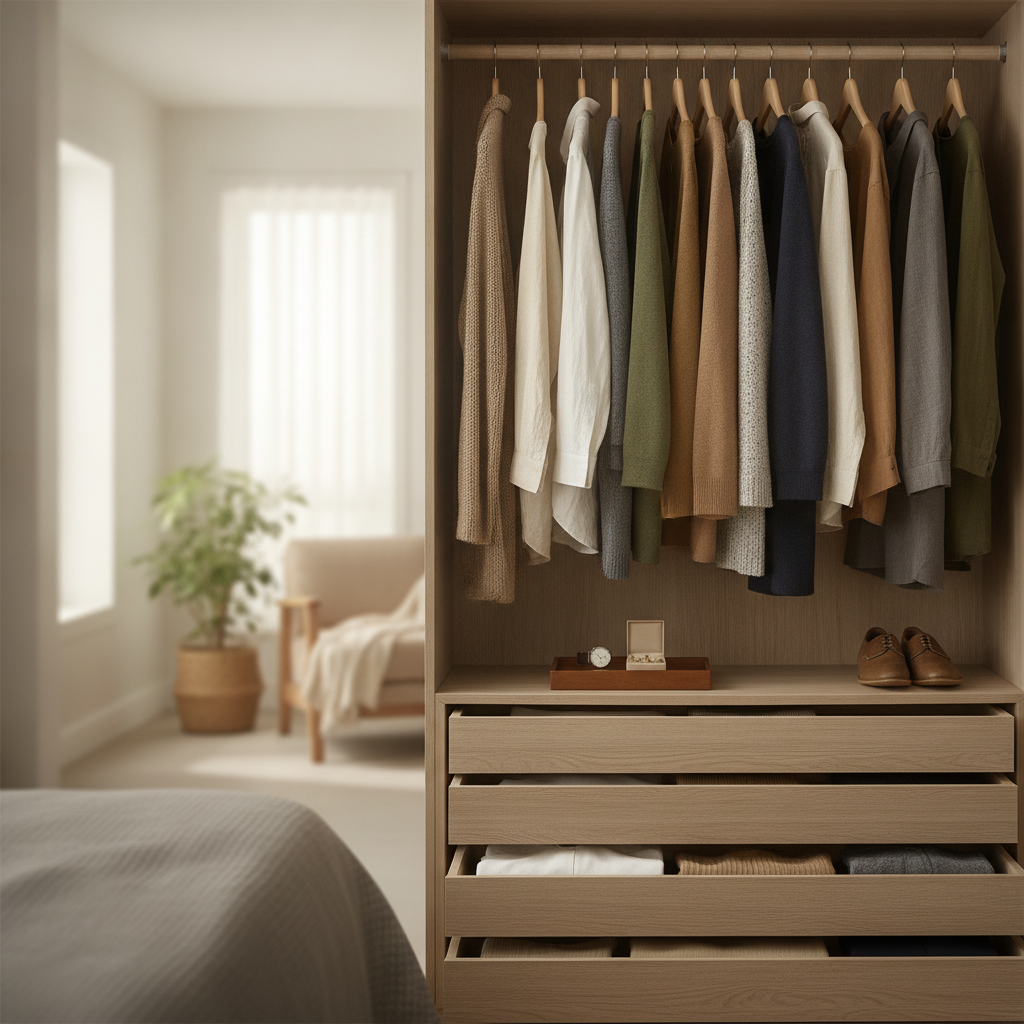
The clothes hanging in a closet represent far more than personal style — they represent a series of daily micro-decisions that quietly drain cognitive energy before the day has properly begun. Most people don't register how much mental effort goes into getting dressed each morning, because the cost is distributed across hundreds of small moments rather than arriving as a single obvious burden. A defined color palette changes that equation entirely, not through minimalism as a philosophy, but through the practical logic of constraint.
The Hidden Cognitive Cost of Wardrobe Variety
Decision fatigue is cumulative. Each choice made — even a low-stakes one — draws from the same finite pool of mental energy available in a given day. A wardrobe built around unrelated colors, competing patterns, and items that don't naturally work together forces the brain into a daily coordination exercise. Over weeks and months, that exercise compounds. Research consistently confirms that people who face more choices earlier in the day perform worse on concentration-dependent tasks later, and the morning wardrobe is one of the earliest and most underestimated culprits.
How a Color Palette Creates Automatic Compatibility
When every item in a wardrobe shares a coherent color story — say, a base of navy, white, and warm camel, or a cooler palette of slate, ivory, and forest green — the number of viable outfit combinations increases dramatically while the effort required to assemble them drops to near zero. Everything works with everything. The decision isn't whether pieces match; it's simply which version of an already functional combination feels right for the day. Brands like Everlane and COS have built entire followings around this principle, designing collections deliberately around limited, interchangeable color ranges.
The Psychology Behind Constraint and Clarity
Counter-intuitively, more options rarely produce better outcomes. When the range of available choices is reduced, the brain shifts from evaluation mode into selection mode — a meaningfully lighter cognitive task. Choosing between three compatible pieces takes a fraction of the mental energy required to assess thirty mismatched ones. This is why uniform dressing, practiced by everyone from tech founders to fashion editors, consistently shows up in conversations about productivity and focus. The palette acts as a pre-made decision framework, doing the thinking in advance so the morning self doesn't have to.
Building a Palette That Reflects a Real Lifestyle
A workable color palette isn't built by copying someone else's aesthetic or following a seasonal trend report. It starts with an honest audit of what already gets worn most often. Most people find, when they actually look, that roughly sixty to seventy percent of their wardrobe sits untouched for months at a time, while a small cluster of pieces carries nearly all the daily weight. Those frequently worn items usually share something — a warmth or coolness of tone, a leaning toward neutrals or a quiet preference for muted color. Identifying that thread and then editing the rest is where the palette begins to take shape.
Practical Color Anchors and How to Use Them
You don't need a formal system or a color theory background to make this work. Start with two or three neutral anchors — pieces in black, white, grey, beige, or navy that can form the foundation of almost any outfit. Then add one or two accent tones that genuinely appeal to you and complement those anchors. For example, if your base is cream and charcoal, a dusty terracotta or sage green works as an accent that adds interest without breaking compatibility. Apps like Stylebook allow you to photograph and catalog existing pieces, making it easy to see at a glance which colors dominate and where the clutter lives. Keep the accent palette tight — two complementary tones is more than enough for a functional wardrobe.
Maintaining the Palette Without Rigidity
Once a palette is established, the real discipline lies in what doesn't enter the closet. Impulse purchases rarely fit a defined palette — they tend to be the brightly patterned piece bought on holiday or the trend-forward item that seemed essential in the store and never gets worn at home. Stores like Uniqlo make palette building more practical by offering core basics in consistent seasonal colorways that rarely veer far from the neutral spectrum. The goal isn't a completely static wardrobe, but a stable one. Seasonal updates work well when they stay within or adjacent to the existing palette rather than introducing entirely new directions.
A wardrobe built around a defined color palette is ultimately a form of self-knowledge translated into practical structure. The benefit isn't aesthetic uniformity — it's the quiet accumulation of energy that would otherwise be spent on decisions that don't matter. Every morning that passes without wardrobe friction is a morning where cognitive resources stay intact for things that do. The palette doesn't limit personal expression; it focuses it, and in doing so, returns something more valuable than variety: a start to the day that feels settled before it's really begun.